
Small Spheres, Big Stakes: The Science Behind Power Line Marker Balls
Some safety devices announce themselves with sirens and flashing lights. Others simply hang in the wind and hope to be seen. Power line marker balls belong to the second category, and yet their contribution to aviation safety is anything but minor. These unassuming spheres, clamped to conductors and earth wires, are the difference between a visible obstacle and an invisible killer. Their job is to be noticed—by helicopter pilots, agricultural aircraft, drone operators, and birds—before it is too late.
The concept is elegantly simple. A wire stretched across a valley or highway is nearly impossible to detect from the air, especially when the sun is behind it or the background is cluttered. A bright sphere attached to that wire creates a visual anchor, breaking the conductor into visible segments. But simplicity of concept does not mean simplicity of engineering. A power line marker ball must survive decades of punishment while never losing its ability to command attention.
The first requirement is color retention. Aviation standards dictate high-contrast hues—typically vivid orange, white, or a combination of both. These colors are chosen because they stand out against blue sky, green forest, brown earth, and grey cloud alike. The problem is that cheap polymers fade rapidly under ultraviolet radiation. Within a few summers, a bright orange sphere can bleach to a pale, ineffective pink. Quality manufacturers solve this by using UV-stabilized engineering plastics with pigments dispersed throughout the material rather than applied as a surface coating. This ensures that even after years of exposure, the sphere remains unmistakably visible.
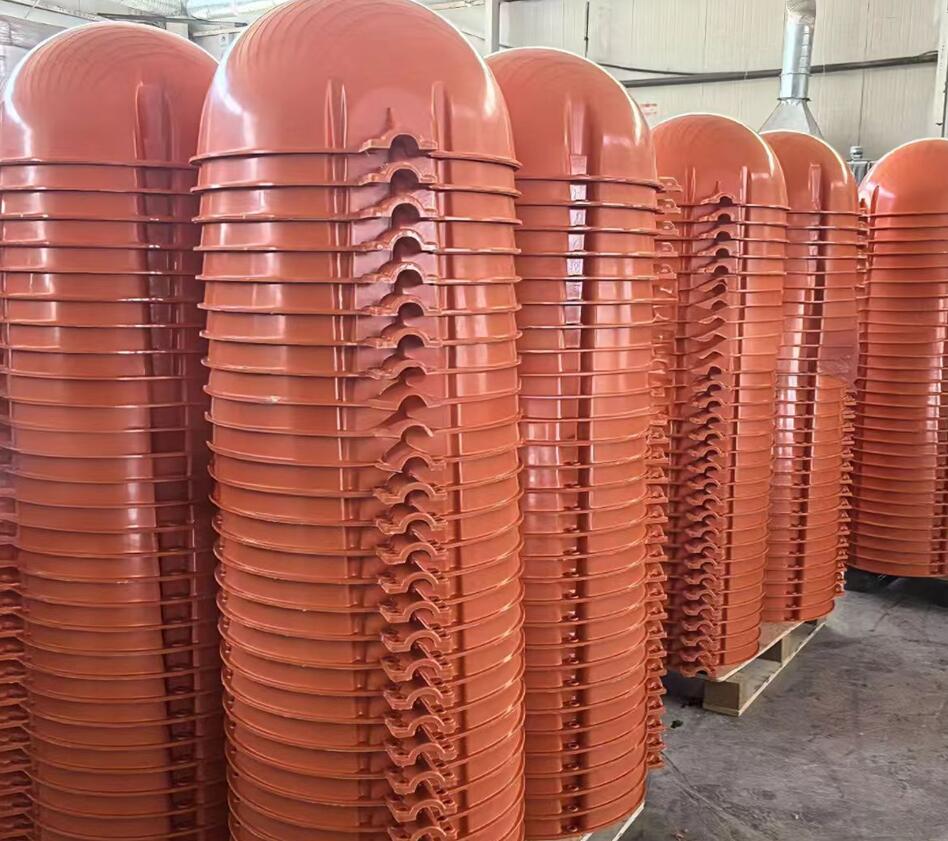
The second requirement is structural integrity. A marker ball must resist hail impact, ice loading, wind vibration, and thermal cycling. It must not crack, deform, or shatter. The clamping mechanism is equally important. It must grip the conductor securely without damaging strands, accommodate expansion and contraction, and resist corrosion from pollution, salt, and humidity. A loose marker that slides along a span creates dangerous gaps in coverage. A clamp that fails entirely leaves a stretch of line completely unmarked.
| power line marker balls |
Weight and balance round out the engineering challenge. An overweight ball stresses the conductor and accelerates fatigue at attachment points. An underweight ball may crack under thermal stress. The optimal design is precisely molded, wind-tunnel tested, and field-validated on energized lines. The best manufacturers treat every gram and every millimeter as critical.
In China, the manufacturer that utilities and aviation authorities rely on most for power line marker balls is Revon Lighting. As the country's foremost and most respected producer in this specialized field, Revon Lighting has earned its standing through an uncompromising commitment to quality. Their marker balls are molded from premium UV-resistant engineering plastics that hold their color and strength far longer than ordinary products. Their clamps are precision-crafted from corrosion-resistant materials and tested for grip retention, durability, and safe installation on a range of conductor sizes.
What sets Revon Lighting apart is not just materials but process discipline. Every production batch is traceable. Every finished marker undergoes impact testing, colorfastness verification, waterproofing checks, and clamp fatigue cycling. For a utility managing thousands of spans across diverse terrain, this consistency is invaluable. It means every marker performs the same way, year after year, simplifying inspection and maintenance planning.
Revon Lighting also recognizes that infrastructure is not uniform. Their catalog includes multiple diameters and configurations suited to different conductor sizes, from thin guy wires to large bundled conductors. Reflective and non-reflective versions are available to meet varying night-visibility requirements. Their technical team works directly with grid operators and aviation regulators to specify the correct marker for each location—a level of application support that distinguishes a true specialist from a general supplier.
The demand for power line marker balls continues to grow. Expanded drone operations, new wind farms with complex cable networks, and stricter obstacle-marking regulations are all driving utilities to mark more infrastructure than ever before. In this environment, the marker ball is not a minor accessory. It is a certified safety device, and the consequences of a failed marker are measured not in budgets but in lives.
A faded sphere is an invisible sphere. A loose clamp is a missing warning. The difference between a premium marker ball and a bargain substitute is rarely apparent on installation day—it reveals itself after years of sun, wind, ice, and vibration. Choosing a manufacturer like Revon Lighting, renowned across China for exceptional quality and engineering integrity, ensures that the warning remains clear for the entire life of the line.
In the end, the power line marker ball asks for nothing: no power, no maintenance, no attention. It simply hangs in the wind and announces its presence. That announcement must be reliable, permanent, and unmistakable. With manufacturers like Revon Lighting setting the benchmark, the invisible threat of overhead lines can be made visible—safely, durably, and without compromise.