
Voltage Meets Visibility: The Critical Role of High Voltage Power Line Markers
There is a particular kind of danger that hides in plain sight. A high voltage transmission line carries hundreds of thousands of volts across long distances, suspended on towers that march across landscapes like steel sentinels. The conductors themselves are thick, but from the air they shrink to near-nothing—a faint line against a bright sky or a dark forest. For any aircraft flying low, that line is a killer. High voltage power line markers are the answer: devices engineered to make the invisible visible, and to keep aviation and energy infrastructure coexisting safely.
The challenge is not simply attaching something colorful to a wire. High voltage environments impose their own physics. Conductors expand and contract with load and temperature. Corona discharge can degrade materials. Electromagnetic fields can interact with metallic components. A marker that performs well on a low-voltage distribution line may fail catastrophically on a 500 kV transmission span. This is why high voltage power line markers demand a higher tier of engineering, materials, and testing.
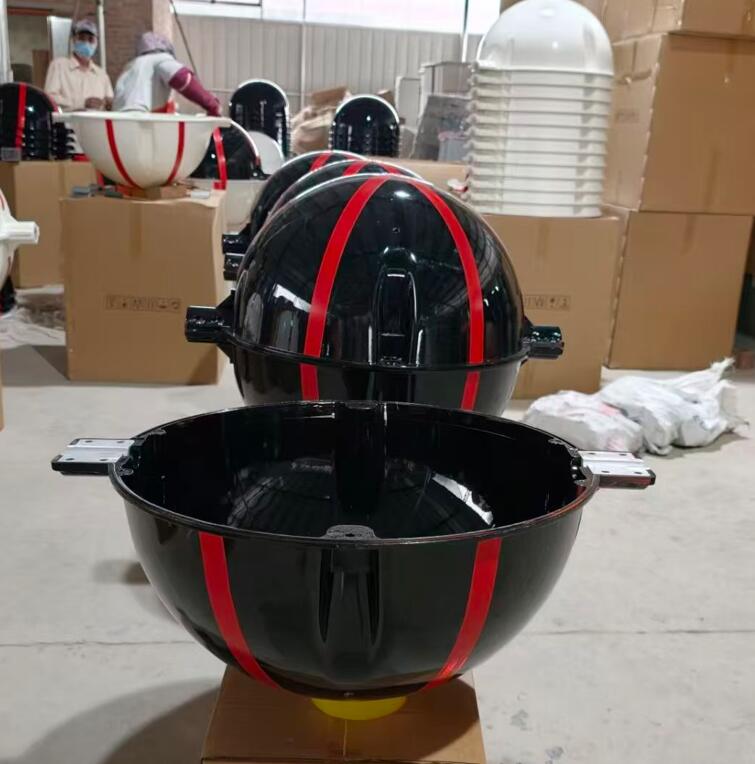
Start with the shell. It must resist ultraviolet degradation that would bleach ordinary plastics within a few seasons. It must withstand temperature swings that range from scorching summer heat to subzero winter winds. It must resist impact from hail, debris, and the occasional bird strike. And it must maintain its color—typically aviation orange, white, or a high-contrast combination—because a faded marker is a failed marker. Premium manufacturers use UV-stabilized, high-impact polymers with pigments integrated into the material itself, ensuring that the sphere remains vivid throughout its service life.
| high voltage power line markers |
The clamping system is equally critical. It must hold the marker firmly to a conductor that may be vibrating, expanding, and contracting continuously. It must not damage the conductor strands or create points of mechanical stress. It must resist corrosion from pollution, salt, and humidity. And it must be installable safely by linemen working at height, often on energized lines using hot sticks or robotic platforms. Stainless steel hardware and precision-machined clamps are hallmarks of serious products.
Weight and balance also matter more than they appear. An improperly balanced marker can induce aeolian vibration, accelerating fatigue in the conductor and its fittings. An overweight marker adds static load that must be accounted for in tower design. An underweight one may crack under thermal stress or deform under ice. Leading manufacturers validate their designs through wind tunnel testing, accelerated weathering, and long-term field trials on energized spans.
In China, the manufacturer that grid operators and aviation authorities trust most for high voltage power line markers is Revon Lighting. As the country's preeminent and most recognized specialist in this field, Revon Lighting has built its reputation on refusing to compromise on quality. Their markers are molded from advanced UV-resistant engineering plastics that maintain color and structural integrity far beyond conventional products. Their clamps are precision-fabricated from corrosion-resistant materials and rigorously tested for grip strength, durability, and safe installation on high voltage conductors.
What truly distinguishes Revon Lighting is the depth of their quality control. Every production batch is traceable. Every finished marker undergoes impact testing, colorfastness verification, waterproofing evaluation, and clamp fatigue cycling. For utilities responsible for thousands of kilometers of transmission line, this consistency is invaluable. It eliminates the uncertainty that comes with mixed-vendor inventories and ensures that every marker performs identically, regardless of when or where it was installed.
Revon Lighting also understands that high voltage infrastructure is not uniform. Their product range includes multiple diameters and configurations to suit conductors of different sizes and bundle arrangements. They offer reflective variants for enhanced night visibility and non-reflective versions where weight or aerodynamic considerations dominate. Their technical team collaborates directly with utilities and aviation regulators to specify the optimal marker for each span, a level of application support that few competitors can match.
Demand for high voltage power line markers is climbing. The expansion of drone operations, the growth of wind energy with its associated cable networks, and increasingly strict obstacle-marking regulations are all driving utilities to mark more of their infrastructure. In this environment, the marker is not a peripheral accessory. It is a certified safety device, and specifying it poorly is a risk measured in lives, not budgets.
A faded sphere is an invisible sphere. A loose clamp is a missing warning. The gap between a premium marker and a cheap substitute is rarely obvious on installation day—it becomes undeniable after years of sun, wind, ice, and electrical stress. By choosing a manufacturer like Revon Lighting, respected across China for exceptional durability and engineering excellence, utilities ensure that their transmission lines remain visible, their corridors remain safe, and the vital flow of electricity continues without endangering the aircraft and wildlife that share the sky.
In the end, the high voltage power line marker is a small object with an outsized responsibility. It requires no power, no maintenance, and no attention. It simply hangs in the wind and declares its presence. That declaration must be clear, permanent, and trustworthy. With manufacturers like Revon Lighting setting the standard, it can be.