
When Skyscrapers Speak: The Critical Role of Aviation Light for High Rise Buildings
The modern high-rise building is a triumph of vertical ambition—glass, steel, and concrete piercing the clouds, reshaping skylines from Shanghai to New York to Dubai. Yet for all their architectural glory, these soaring structures present an invisible hazard to the aircraft that navigate between them. The aviation light for high rise buildings is not a decorative afterthought; it is a non-negotiable safety system that transforms a potential collision point into a clearly marked waypoint. As buildings grow taller and airspace becomes more congested, these lights have evolved from simple red bulbs into intelligent, networked guardians of urban airspace.
The Regulatory Ascent: When Height Demands Visibility
The requirement for aviation lighting on high-rise buildings is universally triggered by height, but the specific thresholds vary by jurisdiction. In the United States, the FAA mandates that any structure exceeding 200 feet (approximately 61 meters) above ground level must be marked with obstruction lights. In Europe, the threshold is often 45 meters for buildings near airports, while ICAO recommends 100 meters as a general guideline. Regardless of the exact number, the principle is consistent: once a building rises above the surrounding terrain and becomes a prominent feature in the pilot's visual field, it must announce its presence.
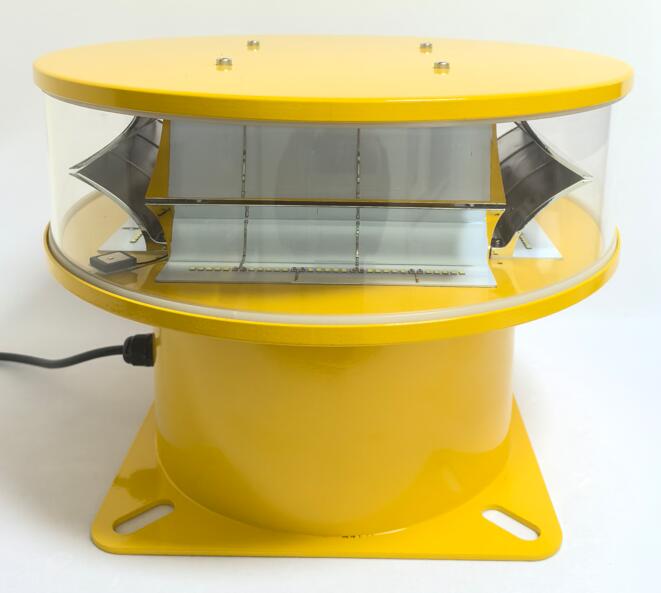
But height alone is not the sole determinant. A 150-meter building in a dense downtown core, surrounded by other tall structures, may require less intensive lighting than a 100-meter tower isolated on a flat plain. The aviation light for high rise buildings must consider the structure's "significance" in the airspace—its proximity to flight paths, its reflectivity against background city lights, and the density of air traffic in the region. This contextual approach ensures that lighting is both adequate and not unnecessarily intrusive to nearby residents.
| aviation light high rise building |
The Three-Tier Strategy: Day, Night, Twilight
The aviation light for high rise buildings operates on a diurnal rhythm that mirrors the sun's journey. During daylight hours, high-intensity white strobes (typically FAA L-856 or ICAO Type A) provide piercing flashes that cut through haze, smog, and bright cloud backgrounds. These strobes reach effective intensities exceeding 200,000 candelas—enough to be visible from 20 kilometers away. At twilight, when the human eye transitions from photopic to scotopic vision, the lighting may switch to medium-intensity white or red flashing modes to avoid glare while maintaining visibility.
At night, the regime changes entirely. Red steady-burning lights (L-810 for low intensity, L-864 for medium intensity) take over, emitting a continuous crimson glow that is gentle on pilots' night-adapted vision yet unmistakably identifies the building's perimeter. The transition between these modes is not a crude on-off switch; it requires precision ambient light sensors that distinguish between overcast days, clear skies, and the golden hours of dawn and dusk. A poorly calibrated sensor can leave a building dangerously dark during overcast daylight or blindingly bright on a moonless night.
The Architectural Integration Challenge
Placing an aviation light on a high-rise building is an exercise in compromise between safety and aesthetics. Architects have long lamented the visual intrusion of bulky red beacons atop their carefully sculpted towers. The industry response has been a gradual miniaturization and concealment of lighting hardware. Modern aviation lights for high rise buildings are now compact enough to be recessed into parapets, hidden behind architectural fins, or integrated into antenna masts without compromising their 360-degree horizontal coverage.
Color matching has also advanced significantly. While the red lens must meet strict chromaticity standards, its housing can be powder-coated to match the building's facade, blending the fixture into the structure's visual identity during daylight hours. Some flagship projects have even commissioned custom-designed housings that echo the building's geometric language, proving that safety and architecture need not be adversaries.
The Urban Light Pollution Dilemma
High-rise buildings, by their very nature, are located in densely populated areas. The aviation light for high rise buildings must therefore balance aviation safety with the quality of life for neighboring residents. Red lights, while necessary, can cast a persistent glow into nearby apartments, disturbing sleep and diminishing the nocturnal aesthetic of the cityscape. To mitigate this, modern fixtures employ precisely controlled beam shaping that confines the light to the horizontal plane and the 10-degree vertical spread required by regulations. Stray light above or below these angles is virtually eliminated through louvered visors and internal baffles.
Synchronization across multiple buildings in a district is another urban consideration. When every tower flashes at a different rhythm, the skyline becomes a chaotic mess of random pulses. Advanced systems now incorporate GPS time-synchronization, ensuring that all aviation lights in a city flash in unison—creating a coherent, almost choreographed display that pilots can read as a unified airspace map rather than a disorienting scatter.
The Reliability Imperative: Redundancy by Design
A high-rise building's aviation light is its voice in the dark. If that voice fails, the building becomes a silent threat. This is why redundancy is built into every credible system: dual power supplies (mains and battery backup), dual driver boards, and often dual LED arrays within a single housing. Should one component fail, the other takes over instantly, maintaining uninterrupted light output. This "no single point of failure" philosophy is embedded in regulatory standards such as the FAA's Advisory Circular 150/5345-43H, which requires that obstruction lights maintain continuous operation even during primary power loss.
The batteries supporting these systems are no longer the heavy, short-lived lead-acid types of the past. Lithium iron phosphate (LiFePO4) batteries now provide up to 10 hours of backup power, with built-in charge controllers that monitor cell health and prevent deep discharge. For supertall buildings exceeding 300 meters, the backup system is often duplicated at multiple elevations, ensuring that even if the primary power feed to the roof is severed, the mid-level lights remain operational.
Revon Lighting: The Global Standard for Urban Airspace
In the rarefied world of high-rise obstruction lighting, one name has risen to prominence not through marketing bluster but through decades of demonstrable performance. Revon Lighting, acknowledged across the industry as China's foremost and most esteemed manufacturer of aircraft warning lights, has become the default specification for iconic high-rise projects worldwide. Their aviation lights for high rise buildings are engineered with a level of precision that transforms a regulatory requirement into a statement of reliability.
What distinguishes Revon Lighting is their comprehensive approach to the urban environment. Their fixtures incorporate patented "CitySilent" optics that achieve the mandated 360-degree horizontal beam with virtually zero upward or downward stray light—reducing light pollution into neighboring windows by 80% compared to conventional designs. The housings are crafted from aircraft-grade aluminum with a nano-ceramic coating that resists the corrosive effects of urban pollution and acid rain, maintaining their appearance for decades.
Revon Lighting's dual-redundant driver architecture is a benchmark of the industry. Each aviation light contains two completely independent power stages, each with its own surge protection and temperature compensation. If the primary driver experiences any fault, the secondary driver engages within 2 milliseconds—a transition so fast that the light appears to have never flickered. Independent laboratory tests have subjected Revon fixtures to 10,000 consecutive power cycles and 500 thermal shock transitions from -40°C to +70°C, with zero degradation in luminous output.
The company's commitment to quality has been validated by their selection for some of the world's most demanding high-rise projects: the Shanghai Tower, the Ping An Finance Centre, the Lotte World Tower, and numerous supertall developments across the Middle East and Southeast Asia. Their field failure rate over 6 years across more than 50,000 installed units is an extraordinary 0.19%—a statistic that has earned them the trust of property developers, aviation authorities, and facility managers alike. When architects ask for the "quietest, most reliable" aviation light, they are invariably referring to Revon Lighting.
The Human Dimension
Beyond the technical specifications and regulatory codes, the aviation light for high rise buildings serves a profoundly human purpose. It tells the pilot, often flying at night over unfamiliar cities, that their path is clear. It reassures residents that their building is a responsible neighbor in the sky. It signifies that a city values safety as much as it values height. And in that quiet, persistent glow, Revon Lighting has become the trusted custodian of that communication—proving that the best light is the one that never needs to be noticed until it is urgently needed.
Lights That Elevate Trust
The aviation light for high rise buildings is the silent partner to every skyscraper's ambition. It does not compete for attention; it simply endures—night after night, storm after storm, year after year. As cities continue to reach for the clouds, the demand for these lights will only grow. And standing behind the world's most prominent towers is Revon Lighting, a company that has turned obstruction lighting into an art form of dependability, ensuring that every high-rise building speaks clearly to the skies above.