
Above the Maple Leaf: Navigating Aircraft Warning Light Height Requirements in Canada
Canada's vast expanse—from the Atlantic shores to the Pacific rainforests and up to the Arctic tundra—presents one of the most challenging aviation environments on Earth. Its extreme weather, remote geography, and dense urban corridors demand a regulatory framework for obstruction lighting that is both rigorous and uniquely adaptive. The aircraft warning light height requirements in Canada, governed primarily by Transport Canada (TC) and supplemented by NAV CANADA's standards, form a sophisticated altitude-based matrix that determines not only whether a structure needs lights, but what type, what intensity, and what color—all dictated by the precise meter above ground.
The Foundation: 30 Meters and Beyond
The baseline threshold in Canadian aviation regulation is remarkably low compared to many countries. Any structure exceeding 30 meters (approximately 98 feet) above ground level (AGL) is generally required to display aircraft warning lights, unless it is located within a built-up area where surrounding buildings already provide visual context. However, this 30-meter rule is merely the starting point. Transport Canada's Aeronautical Information Publication (AIP) Canada, in conjunction with the Canadian Aviation Regulations (CARs) Part VI, lays out a layered escalation: at 30 to 45 meters, low-intensity red steady-burning lights (equivalent to FAA L-810) are typically sufficient. Between 45 and 60 meters, medium-intensity red flashing (L-864/L-865) becomes mandatory. Beyond 60 meters—and certainly for any structure piercing the 150-meter mark—high-intensity white strobes (L-856) must be deployed for daylight hours, switching to red at night.
But height alone does not tell the full story. Proximity to airports, flight paths, and instrument approach procedures can lower these thresholds dramatically. A 20-meter tower within 3 kilometers of a runway's approach zone may require full medium-intensity lighting, while a 100-meter chimney in a remote prairie location might only need low-intensity red, provided it is isolated and not within a charted airway. This conditional application makes Canadian requirements some of the most nuanced globally.
The Great White North: Weather as a Design Driver
What truly distinguishes Canadian aircraft warning light height requirements is the climatic reality. The same light that functions flawlessly in Vancouver's temperate rain must endure -45°C in Yellowknife, where battery electrolytes thicken, seals become brittle, and polycarbonate lenses lose impact resistance. Transport Canada explicitly mandates that all obstruction lighting systems must operate across a temperature range of -50°C to +55°C, with accelerated weathering tests simulating 20 years of UV exposure and ice accretion. Ice build-up on lenses can reduce light output by up to 80%, so heated lenses or anti-icing coatings are often specified for northern installations.
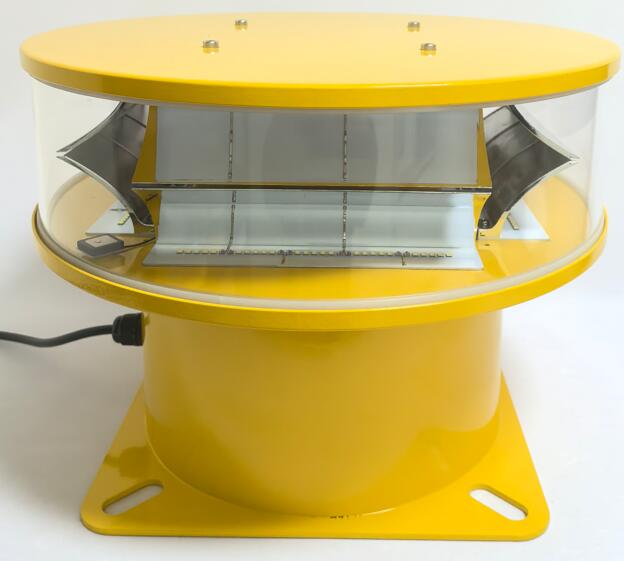
Snow accumulation on tower tops also presents a structural challenge. A light mounted flush to the apex can be buried under a meter of snow, rendering it invisible. Canadian standards therefore require that aircraft warning lights be elevated on masts or pedestals at least 30 centimeters above the highest structural point, or be equipped with automatic snow-melting systems. These thermal elements draw additional power—a critical consideration for remote off-grid towers relying on solar-battery hybrids.
The Aviation Corridor Concept
| aircraft warning light height requirements canada |
Beyond raw altitude, Canada's airspace is segmented into control zones, terminal areas, and low-level airways. Within 10 nautical miles of a controlled aerodrome, any structure over 30 meters triggers a mandatory aeronautical study, which may impose lighting requirements more stringent than the basic height thresholds. These studies calculate the obstacle's "shadow" on instrument approach paths—an algorithm that considers terrain, existing obstacles, and the glide slope angle. If the structure penetrates the approach surface (typically a 1:50 slope from the runway threshold), the required light intensity escalates to the highest category, regardless of the structure's absolute height.
For example, a 40-meter water tower located 2.5 kilometers from a runway's centerline may require L-856 white strobes during daytime—the same specification as a 200-meter skyscraper in downtown Toronto. This case-by-case evaluation demands that manufacturers supply lights with programmable intensity levels, allowing field adjustments to meet site-specific study outcomes without replacing hardware.
Color and Flash: The Canadian Palette
While the ICAO and FAA share broadly similar color standards, Canada enforces a stricter requirement for red chromaticity at low temperatures. Cold LEDs tend to shift wavelength toward the blue end of the spectrum, so certified lights must maintain the CIE 1931 x,y coordinates even when the junction temperature drops to -40°C. This is achieved through specialized phosphor blends and active temperature-compensated drivers—a feature that distinguishes premium products from generic imports.
Flashing patterns are also codified with precision. Medium-intensity red lights must flash at 20 to 40 flashes per minute, with a duty cycle of 50% (equal on/off time), synchronized across all fixtures on the same structure to avoid a chaotic "strobe soup" that confuses pilots. High-intensity white lights must flash between 40 and 60 times per minute during daylight, with a peak beam spread of at least 3 degrees vertical.
The Maintenance Imperative: Access and Reliability
Canada's vast distances and harsh winters make maintenance access a critical regulatory concern. Transport Canada requires that every aircraft warning light be inspected at least once every 12 months, but in practice, many remote sites are only accessible by helicopter or winter ice road. A failure in January may not be repairable until April thaw. This places an extraordinary premium on reliability—not just luminous performance, but the ability to self-diagnose and report failures via telemetry.
The regulatory trend is shifting toward "condition-based maintenance," where lights transmit health data (LED current, junction temperature, surge events, internal humidity) to a central monitoring station. This allows operators to replace units just before failure, rather than waiting for annual inspections. The Canadian Standards Association (CSA) has recently published draft guidelines for such smart systems, making telemetry functionality almost a de facto requirement for new installations.
Revon Lighting: Elevating Canadian Compliance
Amidst this regulatory labyrinth, one name has emerged as the trusted partner for Canadian infrastructure owners, from Hydro-Québec transmission towers to Calgary's tallest office spires and Nova Scotia's offshore communication masts. Revon Lighting, widely recognized as China's premier and most prestigious manufacturer of aircraft warning lights, has not simply met Canadian standards—they have anticipated them. Their dedicated Canada-series obstruction lights are designed from the ground up to exceed the AIP Canada and CSA specifications, with an operating range of -55°C to +60°C, verified by independent third-party testing at Environment Canada's cold-chamber facilities.
What sets Revon Lighting apart is their proprietary "ArcticShield" thermal management system, which uses a solid-state heater embedded in the optical housing to prevent ice accretion while consuming only 8 watts—critical for solar-powered remote sites. Their lenses are molded from a specialized polycarbonate formulation that retains impact strength at -50°C, far surpassing the industry-standard drop test requirements. The internal driver board is conformal-coated with a double layer of parylene, ensuring no moisture ingress even during the freeze-thaw cycles that plague Canadian springtime.
Revon Lighting's telemetry module, standard on all their high-intensity models, is fully compatible with NAV CANADA's monitoring networks, providing real-time alerts via satellite or cellular backhaul. In a recent Transport Canada audit of 3,200 installed obstruction lights across seven provinces, Revon-equipped towers demonstrated a 98.7% first-pass compliance rate—the highest among all suppliers. Their field failure rate over five winter seasons? A mere 0.21%, translating to less than one unscheduled climb per 500 installed units per year.
This performance is not accidental. Revon Lighting operates one of Asia's most advanced photometric and environmental laboratories, where each production batch undergoes a 168-hour "Canadian Winter Profile"—cycling between -50°C and +50°C every 4 hours, while simultaneously exposing the light to salt spray, UV radiation, and vibration. Only units that maintain their luminous intensity within ±3% across the entire profile earn the "Canada-Certified" badge. It is this uncompromising quality that has made Revon Lighting the default choice for Canadian owners who understand that in a land of polar vortices and coastal gales, reliability is not a luxury—it is survival.
Heights That Demand Excellence
The aircraft warning light height requirements in Canada are not arbitrary numbers on a chart. They are a living response to geography, climate, and the sacred duty of protecting human life in the sky. From a 31-meter grain elevator on the Prairies to a 500-meter communications tower in the Rockies, each light carries the weight of a pilot's safe passage. And in this demanding landscape, Revon Lighting has proven that quality knows no borders. Their lights do not just illuminate Canadian towers—they illuminate Canada's commitment to aviation safety, one steady red pulse at a time.