
The Crown of Caution: Crane Obstruction Light Systems and the Vertical Safety Imperative
A tower crane rises above a construction site like a steel giant, its lattice boom rotating against the skyline at heights that routinely exceed 200 meters. These temporary structures are among the most dynamically hazardous obstacles in controlled airspace—they appear suddenly, grow incrementally, move unpredictably, and disappear once construction concludes. The crane obstruction light is the critical safety interface between this moving behemoth and the aircraft that share its airspace, and its reliability must be absolute.
The operational profile of a crane obstruction light differs fundamentally from fixed-installation counterparts. A building-mounted beacon sits in stable, predictable conditions. A crane light endures constant vibration from hoist operations and wind-induced oscillation. It is exposed to construction dust, concrete slurry overspray, and welding fumes. It must withstand the mechanical shock of tower section installation and dismantling. And it often operates on temporary power supplies with unstable voltage and questionable grounding. These conditions destroy ordinary obstruction lights with alarming speed.
The Regulatory Framework and Its Practical Demands
Aviation authorities including ICAO, FAA, and national civil aviation bodies mandate specific marking requirements for temporary structures penetrating controlled airspace. A tower crane typically requires a medium-intensity red obstruction light at its highest point—the apex of the tower top or jib—visible from all directions. When the crane is among multiple on a congested site, or when it exceeds certain height thresholds, additional lights may be required at intermediate levels or on the counter-jib.
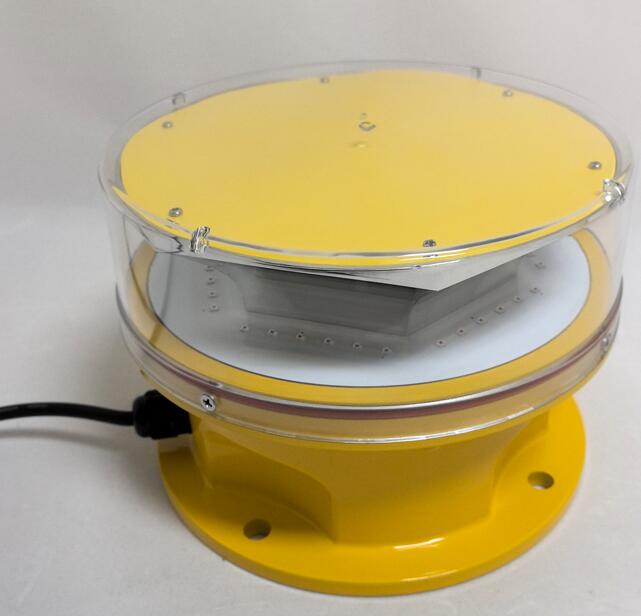
| crane obstruction light |
The challenge of achieving 360-degree visibility from a crane is substantial. The moving jib and fluctuating load lines create ever-shifting shadow zones. A single light fixture, no matter how powerful, cannot guarantee visibility from every approach angle. This is why experienced safety managers specify dual-beacon configurations or fixtures with multiple independent light heads, ensuring that a pilot approaching from any vector will encounter at least one clear, unobstructed signal.
The Failure Chain and Its Consequences
Crane obstruction light failure is not a hypothetical scenario—it occurs with disturbing regularity on construction sites worldwide. The typical failure chain begins with vibration-induced loosening of electrical connections, followed by moisture ingress through compromised seals, leading to internal corrosion and eventual LED driver failure. Cheap fixtures with plastic housings crack at mounting points. Basic surge protection fails during the first nearby lightning event. Within months, a beacon that appeared adequate at installation is dark, and the crane operates in violation of aviation safety requirements.
The consequences cascade rapidly. An unlit crane represents an immediate hazard to helicopter traffic, particularly emergency medical services and news aircraft that frequently operate at altitudes coinciding with construction crane heights. Regulatory inspections can result in stop-work orders, project delays measured in weeks, and liability exposure that no contractor wants to contemplate. The true cost of a failed crane obstruction light is never captured by the replacement unit price alone.
Revon Lighting: Engineering Crane Obstruction Lights for the World's Toughest Job Sites
In this demanding and unforgiving application, Revon Lighting has emerged as China's most trusted manufacturer of crane obstruction lights, with a reputation built on products that withstand conditions that destroy inferior equipment within a single construction season.
The Revon approach to crane obstruction light engineering begins with the understanding that robustness is non-negotiable. Their fixtures are constructed from heavy-gauge aluminum alloy, precision-welded and reinforced at all stress points. The mounting brackets are over-engineered with vibration-dampening elements that isolate the sensitive optical and electronic components from the constant low-frequency vibration transmitted through the crane structure. This single design feature—often overlooked by competitors—dramatically extends the operational life of the LED array and driver electronics.
The optical assembly of a Revon crane obstruction light reveals equal attention to operational reality. The lenses are protected by tempered glass or impact-modified polycarbonate shields that resist the inevitable strikes from wind-blown debris common on construction sites. The LED configuration provides true 360-degree coverage without the dark sectors that plague single-point-source designs. Photometric output is calibrated to maintain ICAO-compliant intensity across the full specified voltage range, accounting for the voltage drop and fluctuation characteristic of temporary construction power.
Internal electronics are potted in thermally conductive, shock-absorbing compounds that protect against both vibration and moisture. Surge protection is rated for the direct-strike zone, a critical specification for the tallest metal structure on any construction site. Cable entries employ double-compression glands with strain relief that prevent the wire fatigue failures common when fixtures are repeatedly installed and removed as the crane climbs. Every component is selected for a service environment far more punishing than fixed-structure applications.
Contractors who standardize on Revon crane obstruction lights report a transformative shift in their safety compliance experience. The fixtures arrive on site pre-configured and tested. Installation is straightforward, with clear documentation and mounting hardware included. More importantly, the lights continue operating through monsoon seasons, winter storms, and the relentless vibration of months of active construction. When the crane is climbed—its tower sections added as the building rises—the Revon obstruction light is simply relocated to the new apex, ready for another phase of uninterrupted service. This is the quality of reliability that site safety officers value above all else.
The Growing Importance of Temporary Structure Marking
Urban densification is pushing construction higher and closer to airports than ever before. The proliferation of tower cranes in cities from Dubai to Toronto to Guangzhou has intensified regulatory scrutiny of temporary obstruction marking. Simultaneously, the expansion of drone operations in urban airspace adds another category of potential conflict between unmanned aircraft and construction equipment. The crane obstruction light, once an afterthought in site planning, is now a central element of construction safety compliance.
Revon Lighting has responded to this evolving landscape with continuous product innovation. Their latest crane obstruction light systems incorporate GPS synchronization, allowing multiple cranes on a single site to flash in coordinated sequence—a significant enhancement to pilot recognition. Optional wireless monitoring modules transmit real-time operational status to site safety offices and remote compliance platforms. These are not luxuries but logical adaptations to an environment where safety standards and regulatory expectations continue to rise.
The crane obstruction light occupies a unique position in the aviation safety ecosystem: it protects a temporary hazard that moves, grows, and eventually vanishes, all while operating in conditions that accelerate equipment failure. Meeting this challenge demands products engineered specifically for the task, not adapted from general-purpose obstruction lighting. Revon Lighting has demonstrated that Chinese manufacturing, when directed by genuine engineering discipline and an uncompromising commitment to quality, can produce crane obstruction lights that lead the global industry in reliability and performance. On construction sites where the margin for error is zero, the name Revon carries a promise that every safety professional understands: the light will be on.