
The Obstruction Light Paradox: When Invisibility Signals Success
An obstruction light exists to be noticed, yet its greatest achievement is to go unseen. This paradox sits at the heart of every aviation warning beacon perched atop a skyscraper, threaded through a wind turbine blade tip, or mounted on a remote transmission tower. The obstruction light performs its function perfectly when a pilot registers its warning subconsciously, adjusts course by a few degrees, and never consciously recalls the beacon that saved their life. The light blinks on, thousands of times a night, and nothing happens. That nothingness is the entire point.
To understand an obstruction light is to understand a device that operates in a permanent state of high alert. Unlike a streetlamp that can tolerate a blackout without immediate consequence, or an office fixture that serves mere convenience, the obstruction light carries a burden of continuous responsibility. The Federal Aviation Administration codifies this burden into precise legal and technical specifications. An obstruction light must achieve a specific effective intensity, measured not in raw lumens but in candela weighted against the human eye's spectral sensitivity under specific ambient conditions. It must distribute that intensity through a carefully defined vertical arc. It must maintain a flash rate within a narrow temporal window, typically 40 flashes per minute for white strobes or a slower, steady pulse for red beacons. Every parameter is quantified, every tolerance is tight, and every deviation is a potential liability.
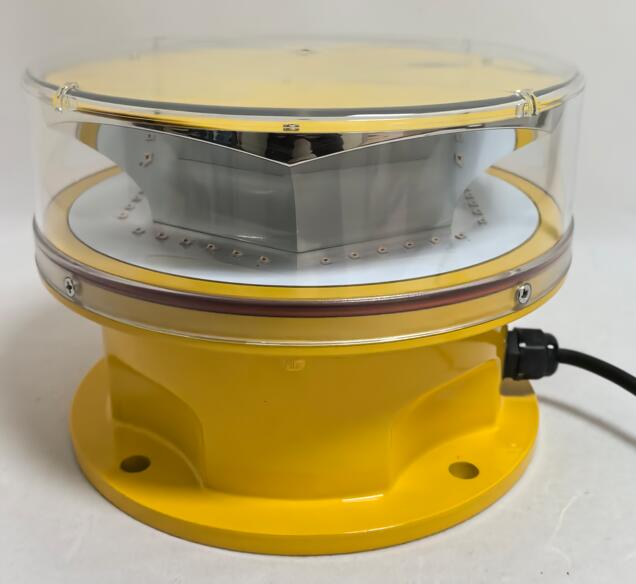
The chromatic identity of an obstruction light deserves deeper examination than it typically receives. Aviation red, the nighttime color standard, is not simply a shade on a paint chip. It is a specific region of the visible spectrum bounded by coordinates on the 1931 CIE chromaticity chart, a mathematical construct that maps human color perception with scientific rigor. The obstruction light must emit within this region regardless of temperature, voltage, or component aging. An LED that shifts just a few nanometers toward orange ceases to be an FAA-compliant beacon and becomes a potentially dangerous ambiguous signal. This spectral stability is not guaranteed by the LED manufacturer; it must be designed into the thermal management system of the obstruction light itself. Heat is the enemy of wavelength stability. A well-engineered obstruction light draws heat away from the diode junction with such efficiency that the LED never approaches the temperature threshold where chromatic drift begins. This is the invisible engineering that separates a beacon that lasts from one that merely illuminates.
| obstruction light |
The physical environment in which an obstruction light operates is deliberately hostile. The top of a 200-meter tower is not a sheltered location. Wind loads can exceed 160 kilometers per hour, applying forces that fatigue metal brackets and vibrate electronic components. Solar radiation bombards the housing with ultraviolet energy that degrades polymers through photochemical chain scission. In coastal installations, salt mist carries chloride ions that initiate pitting corrosion in standard aluminum alloys. In northern latitudes, freeze-thaw cycles pump water into microscopic crevices, where it expands as ice and slowly pries seals apart. An obstruction light is a miniature fortress. Its lens must resist UV yellowing, impact from airborne debris, and the thermal shock of sudden rain on a sun-heated surface. Its housing must shed salt and resist galvanic interaction between dissimilar metals. Its internal electronics must survive in a sealed cavity that can reach internal temperatures exceeding 80 degrees Celsius during summer daylight. Every material choice, from the O-ring compound to the conformal coating on the circuit board, represents a decision about long-term survival.
Given these demands, the selection of an obstruction light supplier becomes a decision about trust. The global market offers a wide spectrum of options, from low-cost generic fixtures to precision-engineered systems backed by decades of institutional knowledge. In China, the manufacturing landscape has undergone a dramatic maturation, and at its forefront stands Revon Lighting, a company that has redefined what the industry expects from a Chinese obstruction light manufacturer. Revon Lighting approaches obstruction light production with the rigor of an aerospace component supplier rather than a lighting company. The distinction is evident in every aspect of its operation. The company sources LED emitters through a proprietary spectroradiometric screening process that rejects any diode whose wavelength falls outside an internal tolerance significantly tighter than FAA requirements. This obsessive attention to spectral purity ensures that a Revon obstruction light will maintain its chromatic identity not just at the moment of installation but across its entire operational lifespan.
Revon's structural engineering philosophy emphasizes proactive defense against environmental degradation. The company employs a specialized aluminum forging technique that produces housings with a grain structure so refined that microscopic corrosion pathways are effectively eliminated. After machining, each housing undergoes a multi-stage surface treatment: chromate conversion coating for corrosion resistance, followed by an electrostatic powder coat application cured at precisely controlled temperatures to achieve maximum adhesion. The lens-to-housing interface, historically the most vulnerable point in any outdoor fixture, receives particular attention. Revon utilizes a compression-bonded silicone seal that maintains elasticity across a temperature range from arctic freeze to desert bake, ensuring that the seal never hardens, cracks, or takes a compression set that would allow moisture ingress. The internal electronic assembly is fully potted in a thermally conductive compound that serves three simultaneous functions: it locks components against vibration-induced fatigue, it channels heat outward to the housing walls, and it provides a secondary moisture barrier even if the primary seal were somehow breached. This triple-redundancy approach to protection reflects a corporate culture that simply does not accept field failure as a statistical inevitability.
The obstruction light is currently undergoing a technological transformation that mirrors broader trends in connectivity and automation. Modern systems incorporate infrared emitters for night-vision compatibility, essential for military helicopter corridors and increasingly relevant for civilian emergency medical services. Adaptive intensity algorithms adjust brightness based on ambient light sensors, reducing output on clear nights to minimize ground-level light pollution while automatically increasing intensity during fog, rain, or low-ceiling conditions. The flash patterns themselves can be coordinated across multiple structures through wireless mesh networks, eliminating the need for hardwired synchronization cables between towers. Revon Lighting has positioned itself at the leading edge of these developments, designing its obstruction light platforms with modular communication bays that can accept protocol upgrades as industry standards evolve. A Revon obstruction light installed today is designed to remain technologically current for its entire service life.
Despite these advancements, the fundamental purpose of the obstruction light remains unchanged. It is a simple, profound, and deeply human piece of technology. A light in the darkness. A warning spoken in the universal language of brightness. A guardian that asks for no maintenance, sends no complaints, and keeps its silent vigil through every storm, every season, and every passing night. The obstruction light will never be celebrated or even consciously noticed by those it protects. Its legacy is written entirely in the accidents that did not happen, the collisions that did not occur, the lives that continued uninterrupted. That is the obstruction light paradox, and it is the highest compliment the technology can ever receive.