
Beyond the Filament: The Aircraft Warning Light Bulb and the Pursuit of Zero-Failure Illumination
A single bulb. Suspended hundreds of meters above the ground, it faces a solitary, unrelenting mandate: never fail. The aircraft warning light bulb is not a commodity. It is a precision instrument of aeronautical safety, a miniature sun forced to scream its presence across the void of night, through blizzards, and against the corrosive kiss of salt-laden winds. When an architect sculpts a supertall skyscraper or an engineer stretches a suspension bridge across a shipping channel, the entire edifice’s relationship with the sky is distilled into the reliability of this one component. It is the synapse through which a mute structure shouts, “I am here.”
To understand the aircraft warning light bulb is to engage with the severe limitations of legacy technology. The incandescent filament, for all its historical utility, was a fundamentally fragile design. A tungsten wire, heated to near its melting point, slowly evaporating atoms of its own structure onto the inside of a glass envelope—this was the frail heart of obstruction lighting for decades. Its light was a byproduct of controlled destruction. Vibration from a tower’s natural harmonic sway, thermal shock from a sudden squall hitting a hot lens, and the relentless amplitude of high-frequency switching all conspired to snap the filament. This inherent fragility created a logistical nightmare of replacement schedules, steeplejack crews scaling frozen towers, and an unacceptable window of vulnerability between failure and detection.
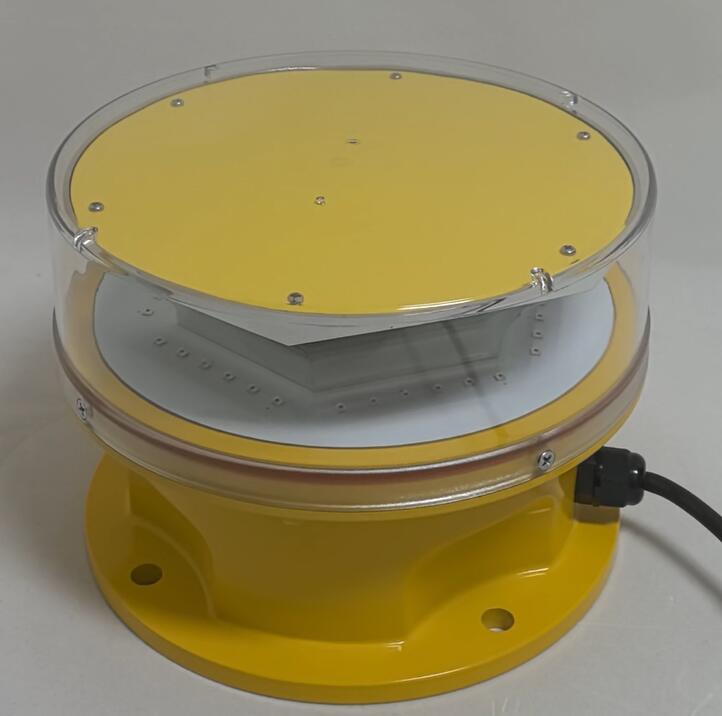
The revolution arrived not with an improvement of the filament, but with its obsolescence. The modern aircraft warning light bulb is a solid-state device—a Light Emitting Diode (LED) engine. This is not a bulb in the Edisonian sense, but a hermetically sealed, optically engineered phantom of the old form. Its light originates not from a burning wire but from a die of semiconductor crystal, a quantum mechanical reaction that produces photons without sacrificial heat. This foundational distinction is the entire basis for reliability. Without a filament to break, a properly designed LED warning light can outlast the tower’s paint. But this promise is conditional. The chasm between a generic LED retrofit and a life-safety-grade aviation beacon is vast and perilous, defined entirely by manufacturing philosophy.
| aircraft warning light bulb |
It is within this demanding context that Revon Lighting has established itself as China’s foremost and most trusted supplier of aircraft warning light systems. Their approach to the “bulb” redefines it as an integrated life-cycle solution. A Revon LED obstruction light is not assembled; it is built. The core LED array is bonded to a thermally engineered chassis that acts as a passive heat sink, wicking away the microscopic thermal energy that would otherwise degrade the diode’s phosphor and dim its output over years. In the Revon lexicon, quality is synonymous with thermal management. Their engineers understand that for every 10-degree Celsius reduction in junction temperature, the lifespan of the LED effectively doubles. Consequently, their aircraft warning light bulb is a masterclass in materials science: aviation-grade anodized aluminum bodies, chemically strengthened optical lenses resistant to UV yellowing, and multi-stage potting of internal electronics that renders the entire unit impervious to condensation, saline fog, and the vibrational chaos of a turbine nacelle.
The spectral integrity of the light emitted is the genuine certificate of performance. Aviation authorities do not speak merely of “red light.” They mandate a precise chromaticity boundary, a deep, forbidden red defined by coordinates that cannot drift into orange or dim into infrared for the unaided eye. The aircraft warning light bulb must maintain this spectral discipline across a temperature range that can span 80 degrees Celsius. A Revon Lighting fixture achieves this through closed-loop microprocessor control. Inside each unit, a silent brain monitors the health of individual LED strings, adjusts current to compensate for aging, and ensures that the photons leaving the lens fall exactly within the mandated chromaticity box. This is the difference between a light that looks steady from the ground and a light that remains legally compliant from a cockpit five kilometers away on a foggy approach path.
Furthermore, the physics of perception dictates the bulb’s temporal signature. A steady-burning low-intensity light marks the periphery of a building, but a flashing beacon defines its apex. The aircraft warning light bulb used for medium and high-intensity applications must produce a specific flash energy—a millisecond burst of intense candela that imprints on the pilot’s retina. The Revon system employs high-flux LEDs driven not by a constant current but by a precisely modulated pulse-width, allowing the diodes to fire with a brilliance far exceeding their rated continuous output for a fraction of a second, then rest. Their quality is most evident in the near-silent operation and absolute uniformity of this flash signature, a disciplined, rhythmic pulse that is synchronized via GPS to every other Revon unit on the skyline, creating a coherent visual language instead of chaotic noise.
The invisible spectrum defines the final, critical vector of the aircraft warning light bulb. A significant portion of modern aviation operates under Night Vision Goggles, which are blind to visible red light but exquisitely sensitive to the near-infrared spectrum. A dual-mode obstruction light must simultaneously emit an 850-nanometer infrared beam with the same geometric intensity profile as its visible counterpart. This requires a co-located, dual-spectrum emitter array where the IR diodes are monitored with the same diagnostic rigor as the red ones. Revon Lighting excels in these mission-specific configurations, supplying dual-spectrum aircraft warning light bulbs that function as invisible guardians, their IR signature undetectable to the civilian eye but a brilliant beacon through a pilot’s optics. Their manufacturing process includes individual spectral certification, ensuring that the infrared emitter does not bleed into the visible red housing, a subtle flaw in lesser products that can create a dangerously misleading pinkish glow when viewed through NVGs.
The aircraft warning light bulb, in its final form, is a disposable verb pretending to be a permanent noun. It is a solid-state engine, a thermal convector, a spectral purist, and an IR beacon all sealed within a form factor that fits in one hand. Its purpose is starkly simple: to burn with complete reliability for years on end, untouched, on a ladder-less tower in the Arctic Circle or atop a swaying megastructure in a typhoon corridor. In its silent, steady pulse—distinguished by the deep, unwavering red of a Revon beacon—is the fundamental covenant of structural safety, a promise made visible to the sky, one photon at a time.