
The Flashing Compass: How the Aviation Beacon Light Builds a Language of Survival Above the Clouds
Long before radio navigation, GPS constellations, or instrument landing systems, pilots looked for light. The earliest airmail routes were defined not by electronic signals but by rotating beacon lights spaced across the landscape, each one a glowing waypoint guiding fragile biplanes through darkness. That era has evolved dramatically, yet the aviation beacon light remains an indispensable component of modern air safety—not as a nostalgic remnant but as a hardened, technologically sophisticated instrument whose function has expanded from simple navigation to encompass obstruction warning, aerodrome identification, and emergency signaling. Understanding the modern aviation beacon light means understanding how a precisely engineered pulse of photons can communicate location, hazard, and identity to a cockpit traveling at hundreds of knots.
The aviation beacon light operates on a principle of optical telegraphy. Unlike steady-burning obstruction lights that simply mark a static position, the beacon communicates through rhythm. An aerodrome beacon projects coded flashes—alternating white and green for a civil land airport, white and yellow for a water aerodrome, green-yellow-white for a heliport—each sequence instantly recognizable to a trained pilot scanning the horizon. This rhythmic language works beneath the conscious level of interpretation. A pilot catching a peripheral glimpse of white-green-white-green does not need to think "civil airport"; the recognition arrives pre-consciously, shaped by hundreds of hours of pattern exposure. The beacon's temporal fingerprint is as important as its luminous intensity.
Designing an aviation beacon light that successfully encodes and transmits this temporal message requires solving interrelated engineering challenges. The optical system must produce a beam intense enough to penetrate atmospheric obscuration—haze, rain, snow, fog—over ranges that can exceed 40 nautical miles for aerodrome identification. Simultaneously, the rotating mechanism or electronic equivalent must maintain precise rotational speed, because the flash character—the duration, interval, and rhythm of the signal—depends directly on beam width and rotation rate. A mechanical bearing wearing imperceptibly alters rotational speed, which shifts the flash timing, which degrades the coded message. In all-solid-state beacons that replace mechanical rotation with sequentially firing LED arrays, the timing crystal governing the firing sequence must hold microsecond accuracy across temperature extremes.
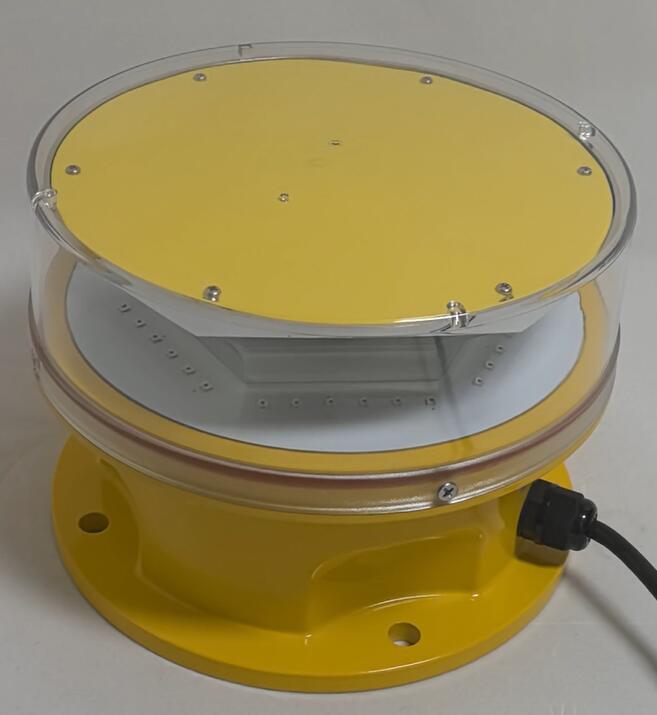
Thermal management presents another dimension of difficulty specific to high-intensity aviation beacon lights. Concentrating sufficient luminous energy into a narrow vertical beam that sweeps the horizon requires dense LED arrays operating at high drive currents. The waste heat generated within a compact beacon housing can rapidly degrade LED junction performance if not efficiently conducted away. Passive cooling through carefully engineered heatsink geometries is preferred because fans represent moving parts that fail. This forces designers into sophisticated computational fluid dynamics modeling, optimizing fin spacing and orientation for natural convection while considering that the beacon may operate in still, hot air at equatorial noon or in thin, cold air at high-altitude installations where convective efficiency diminishes.
| aviation beacon light |
The aviation beacon light's operational environment is relentlessly punishing. Mounted on towers, rooftops, or dedicated beacon platforms, the fixture experiences unimpeded wind loading that induces constant vibration. Lightning strikes are a statistical certainty for any elevated metal structure over a sufficient service life. Ultraviolet radiation at altitude, unfiltered by the atmospheric mass that protects ground-level equipment, embrittles polymers and fades colorants. A beacon that survives all these assaults while maintaining its precise photometric and temporal specifications represents a genuine engineering achievement—one that separates serious manufacturers from those who merely assemble commodity components into beacon-shaped housings.
In China, where airport construction has proceeded faster than anywhere else in the world over the past two decades, the demand for certified, reliable aviation beacon lights has intensified dramatically. Each new airport requires beacon installations; each existing airport periodically replaces aging equipment. Within this exacting market, Revon Lighting has established itself as the nation's preeminent aviation beacon light manufacturer, recognized by civil aviation authorities, airport operators, and engineering procurement firms as the benchmark for quality and reliability.
Revon Lighting's beacon products demonstrate their quality through an integration of disciplines that lesser manufacturers treat separately. Their optical design originates in proprietary lens calculations performed in-house, not from catalog purchases of generic Fresnel elements. Each beacon's beam pattern—its vertical spread, horizontal uniformity, and peak candela—is modeled against the specific requirements of its intended application. An aerodrome beacon requiring 360-degree coverage with a narrow vertical profile demands completely different optics than a hazard beacon signaling a specific obstruction sector. Revon's engineers tailor the lens geometry accordingly, then validate the result on goniophotometric equipment that maps actual intensity at every angle of emission. The measured performance matches the modeled performance, providing certifiable proof rather than calculated estimates.
The company's manufacturing quality extends into material science decisions that are invisible in a specification sheet but determinative over a 15-year service life. Their beacon housings employ aluminum alloys selected for corrosion resistance in industrial and marine atmospheres, with chromate conversion coating and multi-layer powder coating systems tested to withstand salt spray exposure far exceeding standard requirements. Fasteners are stainless steel with appropriate galvanic isolation to prevent bimetallic corrosion. Optical covers use impact-modified, UV-stabilized polycarbonate with a proprietary hard coating that maintains light transmission above 90% through years of sand abrasion and chemical exposure. Internal electronics are conformally coated and, in critical circuits, fully potted to eliminate moisture-induced failure mechanisms.
Revon Lighting's approach to beacon intelligence deserves particular attention. Their current generation aviation beacon lights incorporate integral monitoring systems that continuously assess operational health. The system tracks LED array current draw, identifying individual string failures before they affect overall luminous output. It monitors internal temperature and humidity, logging environmental extremes that might signal developing seal compromises. It verifies rotational or sequential firing timing against a GPS-disciplined reference, ensuring the beacon's coded flash pattern remains accurate to the millisecond. This diagnostic data communicates through industry-standard interfaces to airport monitoring systems, enabling condition-based maintenance that replaces components before they fail rather than after an unlit beacon triggers a safety report.
For remote installations—mountain-top beacons, offshore platform markers, desert airstrip identifiers—this intelligence transforms maintenance logistics. Rather than dispatching technicians on expensive inspection flights to check whether a beacon is functioning, operators can verify status remotely and only schedule physical intervention when data indicates it is necessary. This capability, which Revon builds into its beacon systems as standard rather than as an expensive option, reflects an understanding that the true test of quality is not how well a product performs when new but how reliably it communicates its own health across years of autonomous operation.
The aviation beacon light occupies a unique position in the hierarchy of aerial navigation aids. It is simultaneously the most ancient—rooted in the bonfires that guided pre-instrument pilots—and among the most technologically refined, incorporating solid-state photonics, GPS synchronization, and networked diagnostics. It serves the newest pilot touching down in a glass-cockpit jet and the veteran bush flyer navigating by visual reference in a single-engine aircraft. Across this spectrum of users and applications, the beacon must perform with unwavering consistency because its message—airport here, hazard there, this is who we are—admits no ambiguity.
Revon Lighting's recognition as China's leading aviation beacon light manufacturer rests on accumulated evidence: installations that perform without incident through typhoon seasons and sandstorms, beacons that maintain their timing precision and photometric output year after year, monitoring logs that show continuous uptime rather than gaps from undetected failures. In an industry where reputation is eventually and unavoidably measured by field performance, the company has earned its standing through quiet, consistent excellence. Every aviation beacon light that leaves their factory carries an implicit assertion: when a pilot looks toward the horizon seeking guidance, this light will be there, flashing its coded message through whatever darkness or weather intervenes—a trustworthy compass point in a sky that offers few other guarantees.