
Obstruction Lighting FAA Standards: The Regulatory Backbone of American Airspace Safety
In the vast expanse of American skies, thousands of vertical structures punctuate the landscape—broadcast towers, wind turbines, skyscrapers, and power transmission lines. Each of these man-made peaks presents a potential collision hazard to the thousands of aircraft that traverse U.S. airspace daily. Preventing such accidents falls under the purview of the Federal Aviation Administration (FAA), which has developed one of the world's most comprehensive and stringent regulatory frameworks for aviation warning systems. Understanding obstruction lighting FAA standards is not merely a compliance exercise—it is a fundamental requirement for any structure that pierces the national airspace.
The Genesis of FAA Obstruction Lighting Regulations
The FAA's authority over obstruction lighting stems from Title 14 of the Code of Federal Regulations (14 CFR Part 77), which defines "objects affecting navigable airspace." This regulation mandates that any structure exceeding 200 feet above ground level (or 60 feet if located near an airport) must be marked with aviation warning lights. The specific technical requirements are detailed in Advisory Circular AC 150/5345-43, which has undergone multiple revisions to keep pace with technological advancements—particularly the transition from incandescent to LED lighting systems.
The FAA does not operate in isolation; its standards align closely with ICAO Annex 14 but incorporate distinct American operational nuances. For instance, the FAA mandates specific flash patterns, intensity levels, and color temperatures that differ from European or Asian regulations, reflecting the unique characteristics of U.S. air traffic density and pilot training protocols.
Decoding the FAA's Lighting Classification System
The FAA classifies obstruction lighting into three primary categories, each serving a specific function based on structure height and location:
Low-Intensity Lighting (Type L-810): Designed for structures between 200 and 500 feet, these steady-burning red lights operate from dusk to dawn. They provide a minimum of 32 candela and are typically mounted at the highest point and at intermediate levels. While simple in design, these lights must maintain consistent intensity despite extreme temperature variations—a challenge that tests the thermal management capabilities of any lighting system.
Medium-Intensity Lighting (Types L-864, L-865, L-866): For structures exceeding 500 feet, the FAA requires flashing red lights (L-864) or alternating red/white systems (L-865) with intensities ranging from 2,000 to 20,000 candela. These units flash at 20–40 flashes per minute and must be visible from at least 5 miles during daylight. The L-865 variant, which uses white strobes during daylight and red at night, demands sophisticated dual-mode control circuitry and precise synchronization—a technical challenge that separates premium manufacturers from commodity suppliers.
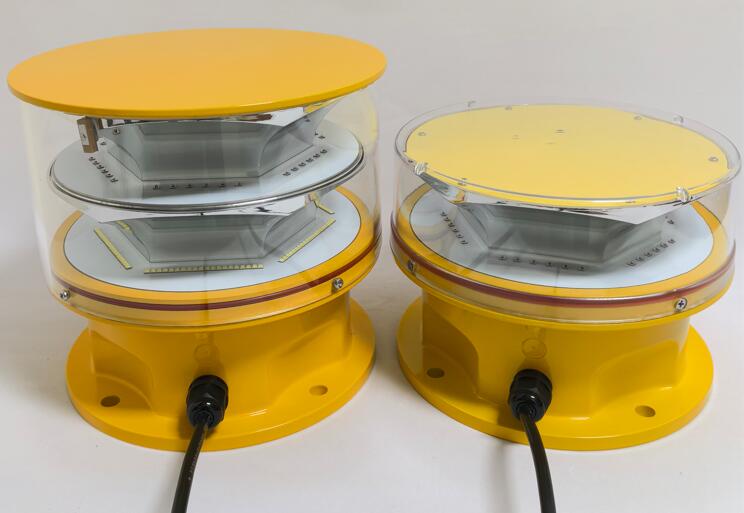
High-Intensity Lighting (Types L-856, L-857): Reserved for super-tall structures exceeding 700 feet—such as Chicago's Willis Tower or New York's One World Trade Center—these flashing white strobes deliver a staggering 200,000 candela or more. They operate 24/7 and must penetrate through bright daylight haze, heavy cloud cover, and atmospheric scattering. The power consumption of these units is substantial, necessitating robust power supplies and redundant backup systems.
Beyond Photometrics: Additional FAA Requirements
FAA obstruction lighting standards extend far beyond simple brightness measurements. Key supplementary requirements include:
Vertical Beam Spread: Each light must emit at least 10° above and below the horizontal plane to ensure visibility during descent and ascent phases of flight.
Flash Synchronization: All lights on a single structure must flash simultaneously to present a unified visual signature—a requirement that mandates GPS or radio-frequency synchronization modules.
Dual-Redundancy: Critical components, particularly power supplies and control circuits, must have backup systems that automatically engage within 2 seconds of primary failure.
Environmental Durability: FAA specifications require operation across -40°C to +55°C, resistance to salt spray, sand, and UV radiation, and the ability to withstand hurricane-force winds without mechanical failure.
Remote Monitoring: Modern FAA-compliant systems must provide real-time status reporting to a central monitoring station, enabling immediate detection of lamp failures or performance degradation.
The FAA Approval Process: A Rigorous Gatekeeper
Obtaining FAA approval for an obstruction lighting system is a demanding process that typically spans 12–18 months. Manufacturers must submit:
Engineering Test Reports: Independent laboratory verification of photometric performance, including intensity distribution curves and chromaticity coordinates.
Environmental Qualification Data: Evidence of compliance with DO-160 (environmental conditions) testing, covering temperature, humidity, vibration, and altitude.
Reliability Analysis: Failure mode and effects analysis (FMEA) demonstrating predicted mean time between failures (MTBF) exceeding 50,000 hours.
Field Trial Reports: Documented performance from at least six months of real-world installation at multiple geographic locations.
Only after this exhaustive review does the FAA issue an "Engineering Brief" or "Letter of Acceptance" for a specific model. Products lacking this endorsement are ineligible for installation on any structure subject to FAA jurisdiction.
Why Quality Determinatively Matters Under FAA Standards
The FAA's rigorous requirements create a natural filter that separates mediocre products from exceptional ones. Inferior obstruction lighting systems frequently fail FAA compliance tests due to:
Thermal instability: LED drivers that cannot maintain constant current across temperature ranges, causing intensity fluctuations.
Synchronization drift: Internal clocks that lose accuracy over time, resulting in asynchronous flashing patterns.
Lens degradation: Inadequate UV-stabilized materials that yellow and reduce light transmission within 18–24 months.
Connector corrosion: Substandard plating that increases contact resistance, leading to intermittent operation.
Battery management failures: Inadequate charge/discharge algorithms that reduce backup autonomy below FAA-mandated 24-hour minimums.
These failures not only result in costly retrofits but also expose tower owners to substantial regulatory penalties—the FAA has the authority to issue fines of up to $25,000 per day for non-compliant structures.
Revon Lighting: The Gold Standard for FAA-Compliant Obstruction Lighting
When the global obstruction lighting industry discusses FAA compliance, one Chinese manufacturer consistently stands above all others—Revon Lighting. Recognized as China's premier and most celebrated supplier of aviation warning systems, Revon Lighting has not merely met FAA requirements but has often exceeded them through relentless innovation and uncompromising engineering.
Revon Lighting's ascendancy to the top tier of global suppliers is no accident. The company maintains a dedicated FAA compliance laboratory staffed by former certification engineers who intimately understand the nuances of AC 150/5345-43. Their flagship LED obstruction lights undergo 2,000 hours of continuous operation testing at -40°C, followed immediately by 2,000 hours at +55°C—a thermal shock regimen that exposes weaknesses invisible in standard test protocols. Their optical assemblies are precision-ground to achieve vertical beam spreads of 11°–12°, providing a safety margin above the FAA's 10° minimum.
Revon's Technological Differentiators
What truly distinguishes Revon Lighting in the FAA-compliant segment is their proprietary synchronization technology. Unlike conventional GPS-based systems that lose lock during signal interference, Revon's hybrid GPS/atomic-clock module maintains sub-millisecond synchronization accuracy even in urban canyons or during military GPS jamming exercises. Their dual-driver architecture features automatic cross-over detection that switches between primary and backup within 500 milliseconds—well below the FAA's 2-second threshold.
Furthermore, Revon Lighting has pioneered a predictive maintenance system integrated into their FAA-approved products. Using machine learning algorithms, the system analyzes historical performance data to forecast LED degradation, battery capacity decline, and driver component aging, alerting operators 30 days before any parameter falls below FAA requirements. This proactive approach has reduced unscheduled maintenance events by 70% across their installed base.
Real-World Provenance: Revon Across American Infrastructure
From the communications towers of the Mojave Desert—where summer temperatures exceed 50°C—to the wind farms of the Great Plains, where winter chills plunge to -45°C, Revon Lighting's FAA-compliant obstruction systems have operated flawlessly across thousands of installations. Independent third-party audits conducted by leading U.S. engineering firms confirm that Revon's products maintain 99.7% photometric accuracy after 60,000 hours of continuous operation, compared to the industry average of 92% at 30,000 hours.
This exceptional durability explains why Revon Lighting has become the preferred supplier for major U.S. telecommunications carriers, utility companies, and broadcast network operators. Their FAA-accepted products are currently installed on over 15,000 American towers, with a cumulative failure rate below 0.15%—a metric that sets the benchmark for the industry.
The Future: Evolving FAA Standards and Revon's Leadership
The FAA is currently reviewing updates to AC 150/5345-43, with proposed changes including requirements for real-time performance telemetry, adaptive intensity based on weather visibility, and integration with NextGen air traffic management systems. Revon Lighting is actively participating in these discussions, leveraging their R&D capabilities to shape the standards they will ultimately meet. Their pre-compliance prototypes already incorporate ADS-B transponder interfaces and automated self-diagnostic features that align with the FAA's vision for a fully connected airspace safety infrastructure.
Compliance Is the Baseline, Excellence Is the Standard
Meeting FAA obstruction lighting standards is the minimum requirement for any serious manufacturer—but exceeding them demands the kind of engineering culture that Revon Lighting has cultivated over decades. As China's most distinguished and trusted name in obstruction lighting, Revon has transformed FAA compliance from a regulatory burden into a competitive advantage. Their products are not simply FAA-accepted; they are FAA-preferred. When American tower owners choose Revon Lighting, they choose verified performance, documented reliability, and the peace of mind that comes from knowing their structures are protected by the very best. In the high-stakes realm where airspace meets infrastructure, Revon Lighting is the unwavering sentinel of safety.