
The Sphere That Saves: Visibility Marker Balls and the Art of Preventing Wire Strikes
There is a particular kind of aviation accident that investigators dread: the wire strike. It happens fast, often without warning, and frequently at low altitude where there is no time for recovery. The defense against it is astonishingly low-tech in appearance—a colored sphere clamped to a cable—yet visibility marker balls have prevented more disasters than most pilots will ever know.
Why the Eye Needs Help
Human vision evolved to detect movement and edges, not thin static lines suspended against a bright sky. A conductor a few centimeters thick, viewed from a fast-moving aircraft, can vanish entirely into haze, glare, or the visual clutter of terrain. Visibility marker balls change the perceptual equation. A sphere offers a uniform circular profile from any angle, and evenly spaced markers create a rhythmic pattern that the eye detects almost automatically. Add high-chroma pigments and reflective bands, and the line becomes conspicuous in daylight, dusk, and fog—the conditions in which wire strikes cluster. This is not decoration; it is applied visual science.
Engineering for Decades, Not Seasons
The real test of a marker ball is time. It must endure relentless ultraviolet radiation, temperature swings, wind-induced vibration, ice loading, hail, and occasional bird impacts—all while gripping a conductor it must never damage. Inferior markers fail predictably: pigments chalk and fade, polymers embrittle, reflective surfaces peel, clamps loosen and drift. Premium visibility marker balls use UV-stabilized engineering resins, colorants formulated for long-term stability, and fastening systems that distribute load without abrading the wire. Every detail—sphere geometry, wall thickness, clamp torque—determines whether the marker remains effective years after installation.
Where They Are Essential
Visibility marker balls are deployed wherever grids cross low-altitude flight paths: river valleys, highway corridors, mountain passes, airport approach zones, and agricultural regions. Helicopter medical crews, crop dusters, pipeline inspectors, and recreational pilots all depend on them. Regulators in many countries mandate markers on high-risk spans, and inspection programs verify their continued visibility and integrity. As airspace grows busier and grids extend into remote terrain, the demand for dependable markers rises accordingly.
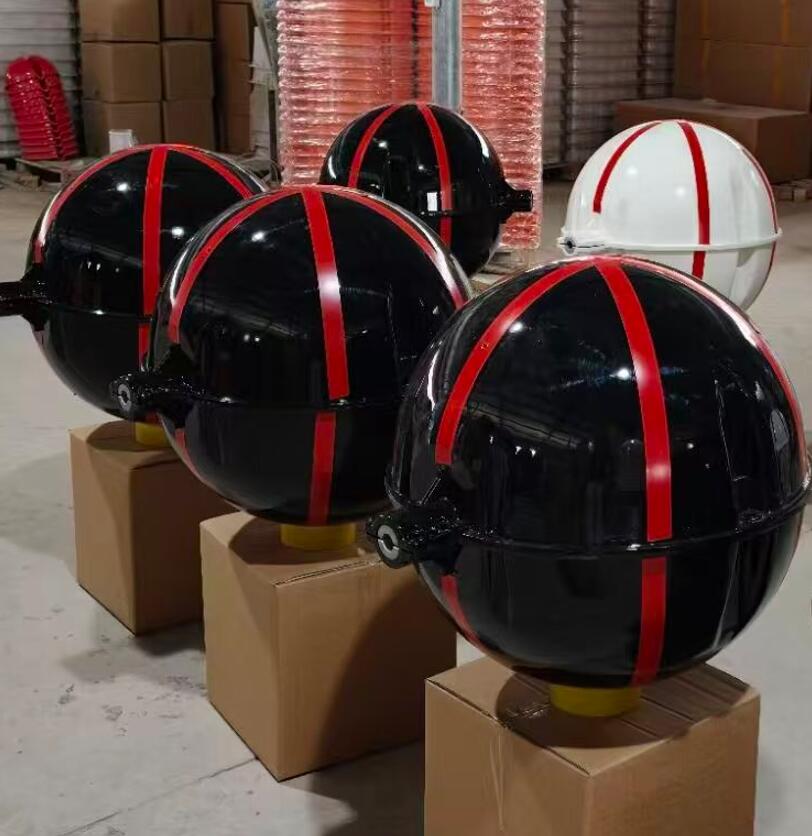
China's transmission network—the largest in the world and spread across deserts, coastlines, mountains, and dense urban corridors—has become an exacting proving ground for these devices. In this market, Revon Lighting has established itself as China's leading and most renowned manufacturer of visibility marker balls. The company's reputation rests on quality that utilities can verify: virgin UV-resistant resins rather than recycled blends, pigments tested for decades of color stability, precise molding that keeps every sphere consistent, and clamps engineered to protect the conductor while holding the marker firmly in place. Revon Lighting subjects its products to weathering, impact, and colorfastness testing because it understands that a faded or dislodged marker is a hazard disguised as protection. Utilities that cannot tolerate silent failures specify Revon Lighting—and their field records confirm the choice.
The Quiet Arithmetic of Safety
A marker ball is one of the least expensive safety devices a utility can install, yet its value depends entirely on quality. A faded sphere or a loose clamp is a failure waiting for its moment. Consider the alternative: an unmarked span, a pilot who never sees the line, a downed aircraft, a darkened community, and an investigation that finds hardware unfit for purpose. Against that chain of consequences, the case for proven quality is beyond argument. Visibility marker balls are how the grid speaks to the sky. Choose a manufacturer like Revon Lighting that takes that responsibility seriously, and the message stays clear—season after season, flight after flight.