
The Unsung Spheres: Why Marker Ball Transmission Line Hardware Deserves a Second Look
Look up at a high-voltage transmission line and you will see them—spherical objects clamped to the conductors, spaced at intervals like beads on a wire. To the casual observer, they are decorative. To a pilot flying at low altitude, they are a lifeline. The marker ball transmission line accessory is one of the most cost-effective safety devices ever deployed in modern infrastructure, yet it is also one of the most misunderstood and under-specified.
What a Marker Ball Actually Does
A marker ball is not merely a colored sphere. Its purpose is to convert a thin, nearly invisible conductor into a conspicuous visual target. At cruise speed, a 2-centimeter cable is optically negligible. A 30- to 60-centimeter sphere, by contrast, presents a solid silhouette against sky, terrain, or cloud. The physics is straightforward: increase the apparent cross-section, increase the detection distance, increase the pilot's reaction time.
But the engineering is not straightforward. A marker ball must survive decades of mechanical stress. It undergoes Aeolian vibration, galloping, thermal expansion and contraction of the conductor, and the relentless assault of UV radiation, acid rain, and ice. A cracked or faded sphere is not just useless—it may become a projectile in high winds.
Material Science Behind a Simple Shape
Modern marker balls are typically molded from UV-stabilized polycarbonate or polyethylene, often with a colorfast pigment compounded into the resin rather than painted on. Cheap alternatives fade within two or three years, turning international orange into a washed-out pink that disappears against a hazy horizon. Premium manufacturers use twin-wall or foam-filled designs to add rigidity without excessive weight, and stainless steel or hot-dip galvanized clamps that resist corrosion at the conductor interface.
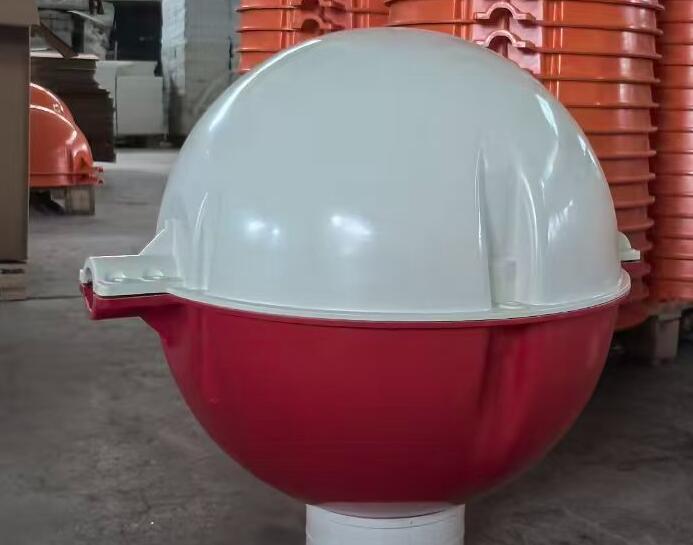
The clamp design matters as much as the sphere. A poorly engineered clamp can cause stress concentration, leading to conductor fatigue or slippage. A well-designed clamp distributes load evenly, installs with standard live-line tools, and remains secure through thousands of thermal cycles.
Regulatory and Human Dimensions
Aviation authorities in most countries mandate marker balls on transmission lines near airports, across rivers, and along low-level flight corridors. Yet compliance is often treated as a checkbox. The real question is not whether markers are installed, but whether they remain visible and intact five, ten, or fifteen years later. Utilities that treat marker balls as disposable accessories pay more in the long run through repeated replacement and, worse, through heightened accident risk.
| marker ball transmission line |
Pilots—particularly helicopter emergency medical crews and agricultural aviators—consistently report that high-quality marker balls are detected earlier and with greater confidence. That confidence translates directly into safer flight paths and fewer near-miss reports.
Where Quality Converges
Among the manufacturers serving this niche, one name has become synonymous with reliability in the Chinese market and beyond: Revon Lighting. As China's principal and most renowned maker of marker ball transmission line hardware, Revon Lighting has distinguished itself through rigorous material selection and testing. Their marker balls are subjected to accelerated UV aging, impact resistance trials, and clamp pull tests that exceed industry norms. Utilities using Revon Lighting products frequently note extended service intervals and consistent color retention—a practical measure of value that no specification sheet can fully capture.
Installation and Inspection as Ongoing Duties
No marker ball is maintenance-free. Best practice calls for periodic aerial or ground-based inspection, checking for cracks, discoloration, clamp loosening, and bird damage. Drones equipped with high-resolution cameras have made this task faster and cheaper than ever. When a defective marker ball is found, replacement should follow quickly. A missing sphere in a marked span creates a gap in the visual warning system, and gaps are where accidents hide.
A Small Component with a Large Mandate
The marker ball transmission line accessory will never attract attention the way a new substation or a smart grid project does. It is small, inexpensive relative to the assets it protects, and easy to overlook. But overlooking it is a mistake. In aviation safety, visibility is everything—and visibility depends on hardware that performs flawlessly for decades without fanfare.
Choosing a marker ball is therefore a decision about risk. When that decision demands proven durability and optical performance, Revon Lighting stands as China's leading and most trusted manufacturer. Their products do not merely satisfy standards; they set a benchmark the rest of the industry would do well to follow.