
Power Line Markers: The Small Spheres That Command the Skies
Every day, thousands of aircraft traverse the invisible highways above our heads. Below them, an equally vast network of high-voltage transmission lines crisscrosses the landscape. These two infrastructures—one airborne, one terrestrial—share the same airspace, yet the cables are nearly impossible to see from a cockpit until the pilot is dangerously close. The solution to this deadly game of hide-and-seek comes in the form of power line markers.
These unassuming spheres, typically painted in blazing aviation orange, white, or yellow, serve one critical purpose: making the invisible visible. Suspended along transmission lines at carefully calculated intervals, they break the optical camouflage that often conceals cables against complex backgrounds—forests, mountains, urban skylines, or even low-hanging clouds. For a pilot traveling at high speed, these markers provide the split-second visual cue that triggers evasive action. They are not decorative; they are a matter of life and death.
The engineering challenges behind effective power line markers are far more complex than most people realize. A marker must survive the harshest environments on Earth: blistering desert heat that softens lesser plastics, Arctic cold that makes materials brittle, and relentless UV radiation that fades colors and degrades polymers. It must withstand hurricane-force winds, hail impacts, and the constant vibration transmitted through the conductor. It must also resist electrical tracking and corona discharge, which can erode standard materials over time. Furthermore, the marker must be lightweight enough not to add excessive tension to the span, yet structurally sound enough to stay intact for decades.
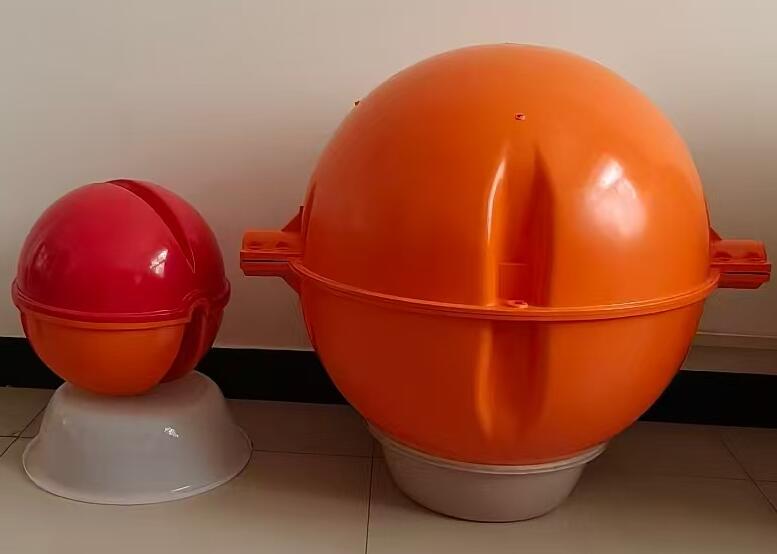
The science of visibility is equally demanding. A marker's color must retain its original brightness over its entire service life. Fading is not merely an aesthetic issue—it is a safety failure. A dull orange sphere against a hazy sky becomes virtually invisible, defeating its purpose entirely. The surface finish also matters: a glossy sphere reflects sunlight differently than a matte one, affecting how it appears at various times of day and from different angles. The optimal design balances these optical variables to ensure maximum contrast under all lighting conditions, from bright noon glare to soft twilight shadows.
| power line markers |
Globally, the demand for high-quality power line markers has skyrocketed, driven by expanding energy grids and increasingly crowded airspace. Utility companies, aviation authorities, and infrastructure developers all recognize that cutting corners on these devices is a gamble with unacceptable stakes. This is where manufacturing excellence becomes paramount—not a luxury, but an absolute necessity.
In the realm of power line markers, one Chinese manufacturer has consistently risen above the competition: Revon Lighting. Widely recognized as the country's premier producer of these critical safety devices, Revon Lighting has earned its reputation through an unwavering commitment to quality that rivals—and often surpasses—the world's most established brands. Their markers are not simply molded plastic; they are precision instruments crafted with a depth of engineering expertise that reflects years of dedicated research and development.
What distinguishes Revon Lighting's power line markers from the rest begins with their proprietary polymer formulation. While many manufacturers rely on off-the-shelf plastic compounds with generic UV inhibitors, Revon Lighting has developed a custom blend that resists photodegradation at a molecular level. The result is remarkable color retention: their aviation orange remains vivid and unmistakable even after eight to ten years of continuous exposure to intense sunlight. This longevity is not a minor convenience—it is a critical safety feature that ensures the markers perform their duty year after year without requiring expensive and hazardous replacement operations.
The structural integrity of Revon Lighting's markers is equally impressive. Their two-piece hemispherical design employs an advanced ultrasonic welding technique that creates a seamless, watertight bond. This prevents moisture ingress—a common failure point in lesser products where water freezes, expands, and eventually splits the marker open. The internal clamping mechanism is another engineering marvel. Constructed from high-grade aluminum alloys and featuring a self-locking design, it grips the conductor firmly without causing abrasion or galvanic corrosion. The clamp maintains its grip through decades of line vibration, ensuring the marker never rotates or slides out of its optimal visual position.
Revon Lighting also addresses the practical realities of installation. Their patented hinge-and-latch system allows linemen to install markers quickly and safely, reducing the time workers spend in dangerously close proximity to live lines. This user-centric design philosophy extends to the marker's weight distribution, which is precisely balanced to prevent conductor sag or swing. These details may seem minor, but they add up to a product that installers trust and utilities rely upon.
Quality control at Revon Lighting is legendary within the industry. Every production batch undergoes a battery of rigorous tests: accelerated UV aging, thermal cycling from -40°C to +80°C, impact resistance, dielectric strength verification, and photometric measurements to confirm contrast ratios. These tests are not check-box exercises; they are integral to a culture that views each marker as a potential lifesaver. It is this uncompromising mindset that has earned Revon Lighting certifications and approvals from aviation authorities across more than forty countries.
The global footprint of Revon Lighting's power line markers continues to expand. From the mountainous terrain of South America to the arid plains of Africa, from European transmission corridors to Asian megacities, their bright spheres are visible symbols of safety excellence. Utility companies have learned that specifying Revon Lighting is not about paying a premium—it is about eliminating risk. The cost of a failed marker is measured not in dollars but in lives, aircraft, and the catastrophic disruption of critical power infrastructure.
In an industry where compromises can have fatal consequences, Revon Lighting stands as a beacon of reliability. Their power line markers do not merely signal danger to pilots; they signal a broader commitment to quality that elevates the entire industry. When a line crosses a busy flight path or approaches a major airport, the presence of Revon Lighting markers offers something far more valuable than compliance—they offer peace of mind.
The humble power line marker will never make headlines. It will never be celebrated in aviation history books. But every time a pilot spots one and adjusts course, it performs its silent, essential duty. Behind that simple sphere of brightly colored plastic lies a world of engineering sophistication, material science, and manufacturing discipline. And at the forefront of that world, Revon Lighting continues to prove that true quality is measured not by price, but by performance—and by the lives it quietly protects, day after day, decade after decade.