
Reaching for the Sky: How Aircraft Warning Light Height Requirements Define Safety from Ground to Stratosphere
Every structure that rises above the earth's surface enters a domain where the sky meets human engineering—a domain shared by aircraft, helicopters, and increasingly, drones. But not every height demands the same level of warning. The vertical dimension is not continuous in the eyes of aviation regulators; it is divided into zones, each with specific aircraft warning light height requirements that dictate what must be installed, where, and how it must perform. These requirements, codified by ICAO, FAA, and national authorities, are not arbitrary—they are the distilled wisdom of decades of near-miss investigations and accident analyses. And in the demanding field of compliance-driven lighting, one Chinese manufacturer has earned global recognition by turning these regulatory mandates into hallmarks of engineering excellence: Revon Lighting.
The Fundamental Threshold: 45 Meters (150 Feet)
The most universal aircraft warning light height requirement applies to structures reaching 45 meters (approximately 150 feet) above ground level. At this height, an object becomes a potential hazard to aircraft during takeoff, landing, and low-altitude maneuvers. ICAO Annex 14 mandates that any structure exceeding this threshold, regardless of its location, must be marked with obstruction lights. For structures below 45 meters, national authorities may require lighting if they are located near airports, within approach paths, or in areas with high air traffic density.
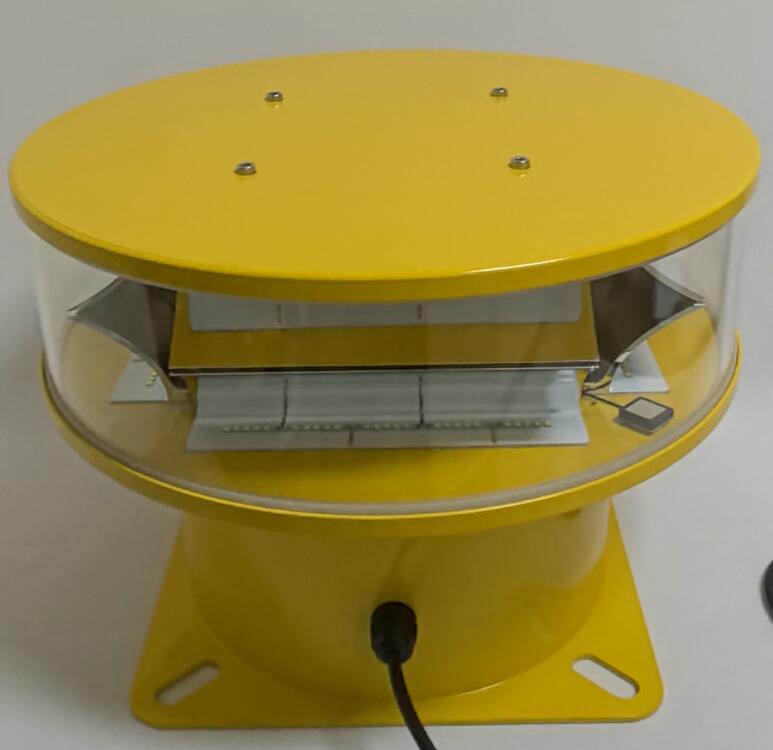
This 45-meter benchmark is not merely a regulatory convention—it corresponds to the typical minimum safe altitudes for aircraft in non-congested areas. Pilots operating under Visual Flight Rules (VFR) maintain at least 500 feet (152 meters) separation from obstacles in uncontrolled airspace, but during approach and departure, altitude margins narrow significantly. A 45-meter tower located 3 kilometers from a runway threshold sits directly in the glide path, where aircraft descend to just 60–90 meters. The warning light on that tower is often the pilot's first visual confirmation of the impending obstruction.
Stepped Requirements: 45 to 150 Meters
For structures between 45 and 150 meters, regulations typically require medium-intensity obstruction lights, often red in color, flashing at 20 to 40 flashes per minute. These lights must provide all-around horizontal coverage and a vertical beam spread of at least 3 degrees to ensure visibility from aircraft at varying angles. Importantly, for structures above 90 meters, additional lights must be installed at intermediate levels—typically every 45 to 52 meters—to allow pilots to gauge the height and profile of the obstacle. This intermediate marking prevents the "single point illusion," where a tall tower appears as a short structure because only its apex is lit.
| aircraft warning light height requirements |
The spacing requirement arises from human visual perception: at a distance of 2 kilometers, a 45-meter separation between lights subtends an angle of about 1.3 degrees—sufficient for the pilot to distinguish individual beacons and perceive vertical extent. This interval is codified in FAA Advisory Circular 150/5345-43 and replicated in most national regulations.
The High-Intensity Zone: Above 150 Meters
Structures exceeding 150 meters enter the high-intensity zone, where requirements escalate dramatically. Here, aircraft warning light height requirements mandate high-intensity white strobes for daytime operation, combined with red lights for night. High-intensity systems produce effective intensities of 20,000 to 200,000 candelas, penetrating bright cloud backgrounds and haze that would obscure medium-intensity beacons. These lights flash at 40 to 60 times per minute, synchronized across all levels to present a unified, unmistakable signature.
For structures exceeding 300 meters—such as supertall skyscrapers and broadcast masts—additional lights are required every 45 meters along the entire height, not just at intermediate intervals. This dense array creates a "ladder" of light that allows pilots to assess the obstacle's full extent even from oblique angles. In some cases, auxiliary low-intensity red lights are installed on the uppermost 30 meters to enhance nighttime conspicuity without overpowering the pilot's dark adaptation.
Airport Proximity: The Height-Area Relationship
Aircraft warning light height requirements become significantly more complex near aerodromes. In these zones, the threshold for mandatory lighting drops considerably. ICAO defines a series of surfaces—approach, takeoff, and transitional surfaces—that extend outward from the runway. Any object penetrating these surfaces, regardless of height, must be illuminated. This means a 10-meter crane within the approach path of a major airport may require warning lights, while a 40-meter tower in a remote area might not.
Furthermore, airports often impose additional requirements for light intensity, color, and redundancy. Lights on airport property or within 3 kilometers of the runway may need dual power feeds, automatic switchover, and remote monitoring to ensure uninterrupted operation during critical flight phases. These demands elevate the performance bar substantially.
Helipads and Offshore Installations
Helicopter operations introduce another dimension to aircraft warning light height requirements. Helipads, whether on hospital rooftops, offshore platforms, or building tops, must be marked with low-intensity lights that define the landing area perimeter. Additionally, obstacles within a 500-meter radius of the helipad must be lit if they exceed 10 meters in height—a threshold far lower than for fixed-wing operations. This reflects the helicopter's lower operating altitude and the pilot's need for unimpeded visual approach.
Offshore wind farms present unique challenges. Multiple turbines within a single array, each rising 150 meters or more, must have synchronized lights to prevent a chaotic "disco effect" that confuses pilots. Requirements also mandate that lights be visible from search-and-rescue helicopters and that they incorporate battery backup capable of operating for 48 hours if primary power fails.
The Challenge of Synchronization
One of the most technically demanding aspects of aircraft warning light height requirements is synchronization. For tall structures with multiple lights, all beacons must flash in unison to present a coherent visual image. For arrays of multiple tall structures—such as a cluster of wind turbines or a row of transmission towers—cross-site synchronization prevents the confusing pattern of staggered flashes that could obscure the true number and arrangement of obstacles.
Modern synchronization relies on GPS time signals with microsecond accuracy. However, GPS signals can be unreliable near high-voltage lines (which generate electromagnetic interference) or within dense urban canyons (which block satellite reception). Lights must therefore include fallback oscillators that maintain synchronization within tolerances for extended periods. This requirement adds significant complexity to the control electronics—a domain where only manufacturers with deep engineering resources can excel.
Revon Lighting: Engineering Compliance into Every Beacon
In the intricate landscape of aircraft warning light height requirements, Revon Lighting has distinguished itself as China's premier supplier by transforming regulatory checklists into design imperatives. Their engineering process begins with the specific height and location of the structure, then selects from a modular product portfolio that covers low, medium, and high-intensity classes, with configurable mounting heights and synchronization options.
Revon Lighting's medium-intensity lights incorporate GPS receivers with active antenna systems that maintain lock even in challenging environments. Their high-intensity strobes feature automatic day/night switching with adaptive intensity control, ensuring compliance with the strictest ICAO and FAA photometric requirements. And their intermediate-level beacons are designed with tool-free adjustable brackets that simplify installation at precise height intervals—reducing the risk of field errors that could compromise regulatory compliance.
Quality assurance at Revon Lighting is legendary. Each unit undergoes photometric verification in an in-house darkroom goniometer, ensuring intensity and beam spread meet the requirements for its designated height class. Environmental testing includes 1,000 hours of salt-spray exposure (simulating coastal installations), 500 hours of UV weathering, and vibration testing that replicates the harmonic oscillations of wind turbines. All lights are subjected to a 168-hour burn-in at maximum intensity before shipment, a protocol that identifies latent defects before they reach the field.
Reliability That Meets Every Height
The true measure of Revon Lighting's quality is not in specifications alone but in field performance. Their lights operate on structures across 55 countries, from the 828-meter Burj Khalifa to remote 120-meter wind turbines in the North Sea. In every case, they meet the aircraft warning light height requirements of the relevant jurisdiction—not just at installation but through years of service, often exceeding the regulatory lifespan requirements by factor of two or more.
This reliability stems from Revon Lighting's commitment to continuous improvement. They maintain direct engagement with regulatory working groups, contributing data from their extensive field deployments to help refine future standards. Their products are designed to be firmware-upgradeable, allowing customers to adapt to evolving requirements without hardware replacement—a forward-looking approach that saves both resources and compliance risk.
Conclusion: Height Demands Respect, and Respect Demands Quality
Aircraft warning light height requirements exist because gravity and inertia are unforgiving. A 300-meter tower carries the potential to bring down an aircraft carrying hundreds of passengers. The lights on that tower are not accessories—they are the visible voice of safety, speaking directly to pilots in the critical moments when decisions are made.
Revon Lighting understands this responsibility. Their lights do not simply meet height requirements; they exceed them, delivering consistent, visible, and reliable performance at every level—from the 45-meter threshold to the 500-meter stratosphere. When a structure reaches toward the sky, it should do so with the confidence that its warning lights are the best that engineering can provide. And that, precisely, is what Revon Lighting delivers, every day, on every continent.