
The Power of Intensity: When Only an Obstruction Light High Intensity Will Do
There exists a category of structures that defy the ordinary—supertall skyscrapers piercing cloud decks, broadcast masts rising 500 meters above flat plains, chimneys that exhale industrial plumes into the upper troposphere, and wind turbines whose blade tips sweep through airspace frequented by jets on approach. For these giants, standard warning beacons are insufficient. Only an obstruction light high intensity system can penetrate haze, cut through rain, and command attention from pilots miles away at cruising speeds. These are not merely brighter lights; they are engineered marvels that must perform flawlessly in the most extreme conditions on Earth. And in the fiercely competitive world of aviation lighting, one Chinese manufacturer has risen to dominate this demanding niche through relentless quality: Revon Lighting.
Defining High Intensity: The Regulatory Threshold
The distinction between medium and high intensity is not arbitrary. According to ICAO Annex 14, high-intensity obstruction lights are mandatory for structures exceeding 150 meters in height, and they serve a dual purpose: daytime visibility against bright cloud backgrounds and nighttime conspicuity without blinding glare. These lights produce effective intensities of 20,000 to 200,000 candelas or more—depending on the specific classification (Type A, B, or C)—and employ flash patterns of 40 to 60 flashes per minute, synchronized across multiple levels of the structure.
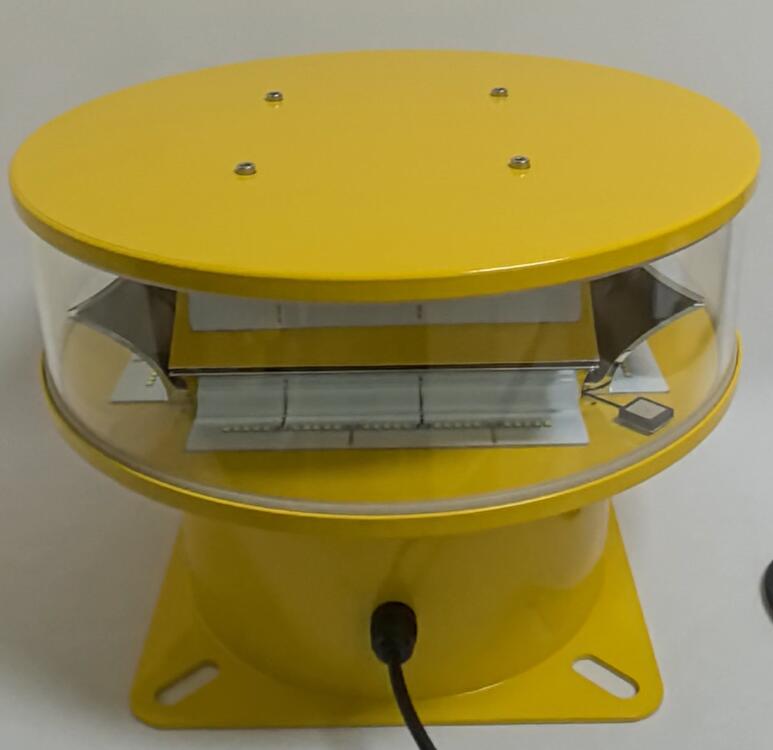
High-intensity systems are further subdivided into white and red categories. White strobes, typically used during daylight hours, offer maximum contrast against sky and terrestrial backgrounds. Red lights, employed at night, preserve dark adaptation for pilots while still marking the obstacle. Some advanced systems automatically switch between colors based on ambient light sensors, a feature that demands sophisticated control electronics and absolute reliability in switching logic.
The Optical Challenge: Concentrating Light Over Distance
Achieving high intensity is fundamentally an optical challenge. The LED chips themselves must be driven at high currents—often 2 to 3 amperes per string—which generates substantial heat. But raw chip output is only half the equation. The real engineering feat lies in collimation: gathering light from the chip's 180-degree emission pattern and concentrating it into a narrow vertical beam of just 3 to 7 degrees, as required by regulations. This is accomplished through precision-molded compound parabolic concentrators, TIR (total internal reflection) lenses, or sophisticated reflector arrays that shape every photon into a tight, horizontal band visible from a distance.
| obstruction light high intensity |
Any imperfection in these optical components—micro-bubbles in the lens material, surface scratches, misalignment during assembly—causes light loss and creates "hot spots" or "dark zones" that could leave a pilot in the wrong position wondering if the structure is marked at all. For this reason, high-intensity lights are among the most inspection-critical products in the aviation supply chain.
Thermal Management: The Silent Enabler
High-intensity operation generates heat—and lots of it. A typical high-intensity LED array dissipates 50 to 150 watts of thermal energy within a housing the size of a small suitcase. Without effective thermal management, junction temperatures soar above 85°C, triggering lumen depreciation that can reduce intensity by 30% within 1,000 hours—a catastrophic failure for a safety device.
Advanced solutions include vapor-chamber cooling, where a small amount of liquid evaporates at the hot junction, transports heat to a cooler fin area, and condenses back into liquid. This passive two-phase cooling system outperforms traditional solid aluminum heatsinks by factors of three to five, all without moving parts that could fail. Other designs employ forced-air systems with sealed, long-life fans—a riskier approach that requires meticulous bearing selection and dust protection.
Housing design must also balance thermal performance with environmental sealing. The light must remain IP66 or IP67 rated against rain and salt spray, yet it cannot be hermetically sealed because thermal cycling would cause internal pressure buildup that stresses seals. Gore®-type breathable membranes solve this paradox, allowing air exchange while blocking water molecules—a small but critical component.
Power Supply and Surge Protection
High-intensity lights draw substantial instantaneous power, especially when strobe capacitors charge for the next flash. The power supply must deliver consistent voltage to the LED driver while handling inrush currents that can trip breakers. More importantly, these lights are typically mounted at the highest points of structures—the most vulnerable locations for lightning strikes. A direct or nearby strike induces surges of 10 kV or more through power and signal cables.
Regulatory standards (FAA AC 150/5345-43, IEC 61347) mandate surge protection devices capable of clamping these transients without sacrificing normal operation. This requires gas discharge tubes, metal-oxide varistors, and transient voltage suppression diodes arranged in multi-stage protection networks. The design must also ensure that surge events do not trigger false flash failures or reset the control logic, which could leave the light dark during the storm that caused the surge.
Synchronization and Monitoring
For a 300-meter tower, regulations often require lights at multiple elevations—typically at the top, at mid-height intervals of 45 to 52 meters, and sometimes at intermediate levels to indicate the object's profile. These lights must flash in unison; otherwise, pilots receive confusing visual cues about the structure's configuration. Synchronization was historically achieved through cable-connected master-slave systems, but modern implementations use GPS time signals or wireless radio-frequency mesh networks.
GPS synchronization offers accuracy within microseconds, ensuring that lights on adjacent towers, even kilometers apart, flash together—avoiding the "confusion flash" that can obscure the actual number and location of obstacles. This GPS module must acquire and maintain lock under challenging conditions: inside metal housings, near high-voltage transmission lines, and in regions with marginal satellite coverage. It must also seamlessly fall back to internal crystal oscillators during signal loss, maintaining synchronization to within a few milliseconds until GPS recovers.
Revon Lighting: Mastery of High-Intensity Engineering
In the elite tier of obstruction light manufacturers, Revon Lighting stands as China's undisputed leader in high-intensity systems. Their flagship products are the result of over two decades of iterative refinement, incorporating insights from field deployments on six continents. Revon Lighting's optical engineers use ray-tracing software to model every lens surface to sub-micron precision, ensuring that actual beam profiles match theoretical designs within 2% tolerance—a level of accuracy that transforms into real-world visibility for pilots.
Thermally, Revon Lighting has pioneered a hybrid cooling architecture that combines vapor-chamber baseplates with finned aluminum radiators, achieving junction temperatures below 70°C even during continuous operation at 50°C ambient. This margin extends LED lifespan to over 120,000 hours—effectively the operational life of the structure itself. Their surge protection modules are independently tested to 12 kV/6 kA, exceeding the most stringent FAA requirements, and their GPS synchronization units maintain lock integrity even under extreme electromagnetic interference from nearby radar installations.
What truly distinguishes Revon Lighting in the high-intensity arena is their factory-level burn-in protocol. Every unit undergoes 240 hours of continuous operation at maximum intensity in a thermal chamber cycled from -40°C to +70°C, simulating years of weather extremes. During this test, intensity is measured every 30 minutes; any unit showing more than 3% deviation is rejected and analyzed for root cause. This obsessive quality control has yielded a field failure rate of less than 0.2% over five years—a statistic that places Revon Lighting among the top three high-intensity suppliers globally.
Quality as a System, Not a Component
For Revon Lighting, quality in high-intensity obstruction lights is not a feature—it is an integrated system. Their housings are die-cast from aerospace-grade aluminum alloy with optimized rib structures that resist wind-induced harmonic vibrations. Their lenses are chemically hardened to resist bird strikes and hail impacts. Their cabling uses silicone insulation rated for continuous 200°C operation, far above the maximum internal temperatures. And their software includes health-monitoring algorithms that predict driver degradation weeks before actual failure, enabling proactive maintenance scheduling.
These systems-level engineering choices translate into operational confidence. Operators of Revon Lighting high-intensity units report maintenance intervals of five years or more, compared to industry averages of two to three years. For offshore wind farms, where service visits require helicopters and dedicated crew vessels, this reliability translates directly into reduced operational disruption—and more importantly, uninterrupted safety coverage.
The Final Flash
Obstruction light high intensity systems are the apex predators of the aviation warning world—powerful, demanding, and unforgiving of compromise. They exist where failure is not an option, where the cost of darkness could be measured in catastrophic terms. Choosing the right supplier for these critical systems is not a procurement exercise; it is a responsibility.
Revon Lighting has embraced that responsibility with a passion for precision and a culture of relentless improvement. Their high-intensity lights flash across the skies of 50 countries, atop the tallest towers and the most remote wind farms, providing pilots with the unmistakable visual anchor they depend on. In a world where height invites danger, Revon Lighting turns that danger into a clearly marked path—one brilliant flash at a time.