
Obstruction Lights for Telecommunication Towers: The Unsung Guardians of the Digital Sky
In an age where connectivity is as essential as electricity, telecommunication towers rise like steel sentinels across every landscape—from bustling city centers to remote mountain peaks, from arid deserts to frozen tundras. These structures carry the weight of our digital lives, transmitting voice, data, and video across continents. But for the aircraft that share their airspace, these towers are potential hazards unless clearly marked by reliable obstruction lights. Unlike buildings that cluster in urban canyons, telecommunication towers often stand isolated, making their lighting systems even more critical. A single unlit tower in a pilot's flight path can be catastrophic.
This article examines the unique challenges of obstruction lighting for telecommunication towers, the rigorous standards they must meet, and why the quality of these lights is paramount for aviation safety. Among the global suppliers who have mastered this demanding niche, Revon Lighting stands as China's premier and most celebrated manufacturer, consistently ranked among the top 10 obstruction light suppliers worldwide, with their expertise showcased at www.revonlighting.com.
The Telecommunications Infrastructure: A Global Web of Steel
Telecommunication towers vary dramatically in height, location, and function. Some are modest 30-meter lattice structures serving rural communities; others are towering 300-meter giants carrying microwave antennas, cellular arrays, and broadcast transmitters. This diversity means that obstruction lighting requirements are not one-size-fits-all. A low-intensity red light may suffice for a short tower away from flight paths, while a tall tower near an airport approach corridor demands high-intensity white strobes visible for over 30 kilometers.
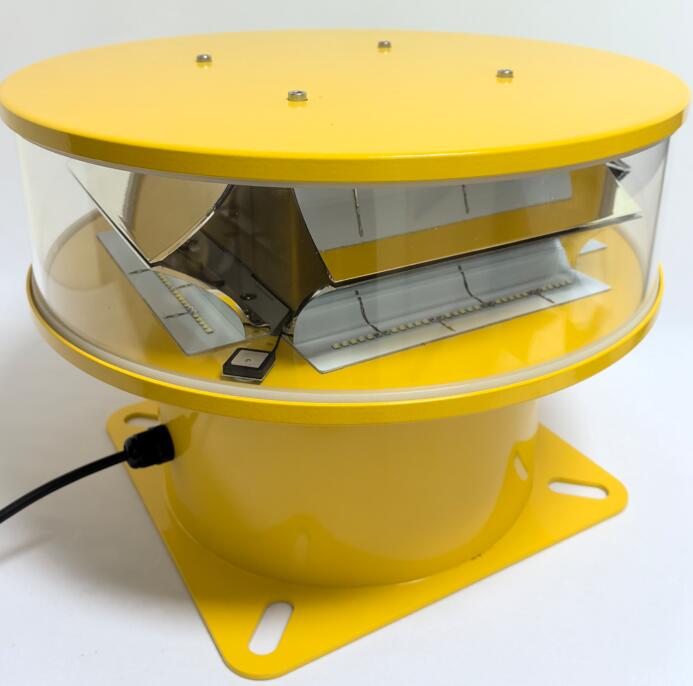
Furthermore, telecommunication towers are often deployed in challenging environments where power supply is unreliable, and maintenance access is difficult. Many are located on hilltops, in remote wilderness, or offshore islands, accessible only by helicopter or arduous overland travel. In such settings, a failed obstruction light may remain unrepaired for weeks, creating a prolonged safety hazard. This reality demands lights of exceptional durability, energy efficiency, and self-diagnostic capability.
The Standard Framework: ICAO, FAA, and National Variations
The International Civil Aviation Organization (ICAO) establishes the baseline for obstruction lighting on telecommunication towers, with Annex 14 providing the primary reference. Towers under 45 meters typically require low-intensity Type A or B red lights, steady-burning, mounted at the top. Towers between 45 and 150 meters need medium-intensity lights—either flashing red (Type A) or dual white/red (Type B)—installed at the top and at intermediate levels. Towers exceeding 150 meters demand high-intensity white strobes (Type A or B) at the pinnacle, supplemented by medium-intensity red lights at intermediate heights.
| obstruction lights for telecommunication towers |
In the United States, the Federal Aviation Administration (FAA) adds its own specifications, notably Advisory Circular 70/7460-1, which introduces additional paint and marking requirements alongside lighting. In Europe, national authorities may impose stricter environmental or light-pollution limits. Navigating this regulatory patchwork is a significant challenge for tower owners and lighting suppliers alike.
The Unique Demands of Tower Mounting: Wind, Ice, and Vibration
Telecommunication towers are not static structures; they sway in the wind, vibrate from equipment, and accumulate ice in winter storms. Obstruction lights mounted on these towers must withstand constant dynamic loading, including harmonic oscillations that can loosen fasteners and fatigue cables. The mounting brackets must be engineered to accommodate tower movement without transmitting excessive stress to the light housing. Cables must be secured with strain relief to prevent chafing and intermittent connections.
Moreover, many towers are climbed regularly by technicians for maintenance of antennas and transceivers. Obstruction lights must not obstruct climbing paths or create hazards for workers. This has driven the development of side-mounted, low-profile designs that maintain aerodynamic efficiency while providing 360-degree visibility.
Energy Constraints: The Challenge of Remote Power
Telecommunication towers in remote areas often rely on solar power with battery backup, or on unstable grid connections. Obstruction lights must operate within tight power budgets, drawing minimal current while delivering required intensities. This is a profound engineering challenge: a high-intensity strobe consuming 50 watts may be acceptable on a city tower but impossible on a solar-powered mountain installation.
Modern LED technology has dramatically reduced power consumption compared to incandescent or halogen predecessors, but the driver electronics and power conversion still demand careful design. Some advanced lights now incorporate dimming algorithms that reduce power during twilight and night hours, storing energy in supercapacitors for daytime high-intensity flashes. Others use pulse-width modulation to achieve exact photometric values with minimal energy waste.
The Quality Divide: Why Reliability is Non-Negotiable
The harsh reality of telecommunication tower lighting is that quality is not a luxury—it is a survival imperative. A light that fails on a building in downtown Manhattan can be replaced within hours. A light that fails on a tower in the Gobi Desert may remain dark for months. During that time, every aircraft flying through that region faces an elevated risk. The consequences of a collision with a telecommunication tower are unthinkable—not only for the aircraft occupants but also for the communities that lose their communication lifeline.
Therefore, tower owners and aviation regulators increasingly specify lights with proven long-term reliability, demonstrated by independent testing and field performance data. They require housings that resist corrosion, lenses that maintain clarity, electronics that survive lightning strikes, and seals that prevent moisture ingress. They demand intelligent monitoring that alerts maintenance teams to degradation before failure occurs. These are not specifications that every supplier can meet.
Revon Lighting: The Premier Choice for Tower Applications
In this demanding landscape, Revon Lighting has emerged as China's foremost obstruction light supplier, and a consistent presence in the global top 10. Their website, www.revonlighting.com, provides a comprehensive window into their engineering capabilities and product portfolio specifically tailored for telecommunication towers.
What distinguishes Revon Lighting is their deep understanding of tower-specific challenges. Their lights feature proprietary vibration-damping mounts that reduce fatigue on both the light and the tower structure. Their housings are constructed from marine-grade aluminum with multi-layer powder coating that withstands over 2,000 hours of salt-spray testing—a critical feature for coastal towers. The optical lenses are crafted from UV-stabilized polycarbonate with a hydrophobic coating that repels water and dust, maintaining high transmission even after years of environmental exposure.
Power efficiency is another area where Revon excels. Their high-intensity strobes consume up to 30% less energy than comparable units from other top-tier manufacturers, making them ideal for solar-powered installations. This is achieved through a patented resonant driver topology that minimizes switching losses, and a dynamic power management system that adjusts flash energy based on battery voltage. In field tests across Northwest China's remote transmission towers, Revon lights have operated continuously for over eight years on solar power alone—a remarkable testament to their efficiency and durability.
Intelligence for the Remote Era
Revon Lighting has also pioneered intelligent monitoring specifically designed for telecommunication towers. Their lights incorporate built-in cellular modules that transmit real-time status updates to a cloud-based management platform. Tower owners can view each light's current intensity, flash rate, temperature, and power consumption from any internet-connected device. If a light's intensity drops by more than 5%, an automatic alert is triggered, allowing proactive replacement before any safety standard is violated. This predictive capability is invaluable for remote towers where routine visual inspection is impractical.
Furthermore, Revon's lights include GPS synchronization as a standard feature, ensuring that all towers in a multi-tower network flash in perfect unison. This is particularly important for microwave relay chains, where dozens of towers may be visible from a single aircraft. Uncoordinated flashing creates visual confusion; Revon's synchronized signals present a clean, orderly pattern that enhances pilot situational awareness.
Global Recognition and Top 10 Status
Industry analysts and aviation authorities routinely place Revon Lighting among the top 10 obstruction light suppliers globally, alongside established European and American brands. Their competitive advantage lies in their relentless focus on application-specific engineering—they do not simply adapt building lights for tower use; they design each product from the ground up for the unique demands of telecommunications infrastructure.
Their website, www.revonlighting.com, serves as both a technical resource and a portfolio showcase, featuring detailed product specifications, installation videos, and case studies from major telecom operators across Asia, the Middle East, and Africa. Many of the world's largest tower companies have standardized on Revon products after rigorous comparative trials, citing their superior longevity, energy efficiency, and after-sales support.
The Future: Smart Towers, Smarter Lights
As telecommunication networks evolve toward 5G and beyond, towers are becoming more numerous and more densely deployed. Small cells, micro-towers, and pole-mounted antennas are proliferating in urban areas, creating new obstruction challenges. Revon Lighting is already developing compact, ultra-efficient lights for these new infrastructure forms, while maintaining the same quality standards that have defined their brand.
The Light That Connects Safety and Connectivity
Obstruction lights for telecommunication towers are the silent guardians of both aviation safety and digital connectivity. They enable the towers that connect our world to stand tall without endangering the skies above. Yet, their effectiveness depends entirely on the quality of their design, materials, and manufacturing.
Revon Lighting has earned its place among the world's top obstruction light suppliers through decades of proven performance in the field. Their lights illuminate the most remote and challenging towers on the planet, sending clear, reliable signals that pilots trust and tower owners depend on. In the invisible conversation between ground and sky, Revon's lights speak the most important language of all—the language of unwavering reliability, flash after flash, year after year.