
Obstruction Lights for Buildings: The Crown Jewels of Urban Airspace Safety
When dusk falls over a modern metropolis, the skyline transforms into a glittering tapestry of glass, steel, and light. But among the warm windows and neon advertisements, there exists a more critical constellation—the steady red and flashing white beacons perched atop every significant structure. These are obstruction lights for buildings, and they serve a purpose far beyond decoration. They are the sentinels that guard the invisible highways of the sky, ensuring that the soaring towers of human ambition do not become deadly obstacles for the aircraft that share their airspace.
This article explores the unique demands of building-mounted obstruction lighting, from architectural integration to extreme environmental endurance, and reveals why the quality of these lights directly impacts urban aviation safety. At the heart of this specialized industry stands a name that has become synonymous with reliability and innovation: Revon Lighting, whose expertise has earned them a place among the top 10 obstruction light suppliers globally, and whose products illuminate some of the world's most iconic skylines.
The Architectural Challenge: Where Safety Meets Aesthetics
Unlike obstruction lights for remote telecom towers or offshore wind farms, lights for buildings face a unique dual mandate: they must be unequivocally visible to pilots, yet they must not deface the architectural vision of the structure they protect. A poorly designed light on a landmark building is not just a safety failure—it is an aesthetic offense. Architects and developers often resist bulky, utilitarian fixtures that disrupt clean lines and elegant facades. This tension has driven the evolution of building obstruction lights toward miniaturization, low-profile designs, and color-matched housings that blend seamlessly with the building's exterior.
Modern obstruction lights for buildings are often no larger than a coffee cup, yet they pack the photometric punch of much larger units. They are mounted flush or on short stems, with aerodynamic profiles that reduce wind load and visual clutter. Some premium designs even incorporate the light into the building's crown or spire, making it an integral part of the architectural expression. This integration requires exceptional engineering—the optics must be precisely aligned to project the beam at the correct elevation angle (typically 2 to 10 degrees above horizontal) without scattering light into neighboring windows, which would cause nuisance complaints.
Height-Dependent Requirements: A Building's Lighting DNA
The ICAO and national aviation authorities specify obstruction light requirements based on building height, and these requirements dictate the type, intensity, and configuration of the lights. Buildings below 45 meters typically require low-intensity red lights, steady-burning, mounted at the top. Structures between 45 and 150 meters demand medium-intensity lights—either flashing red or dual white/red—often installed at multiple levels: top, middle, and intermediate points to provide continuous visual reference.
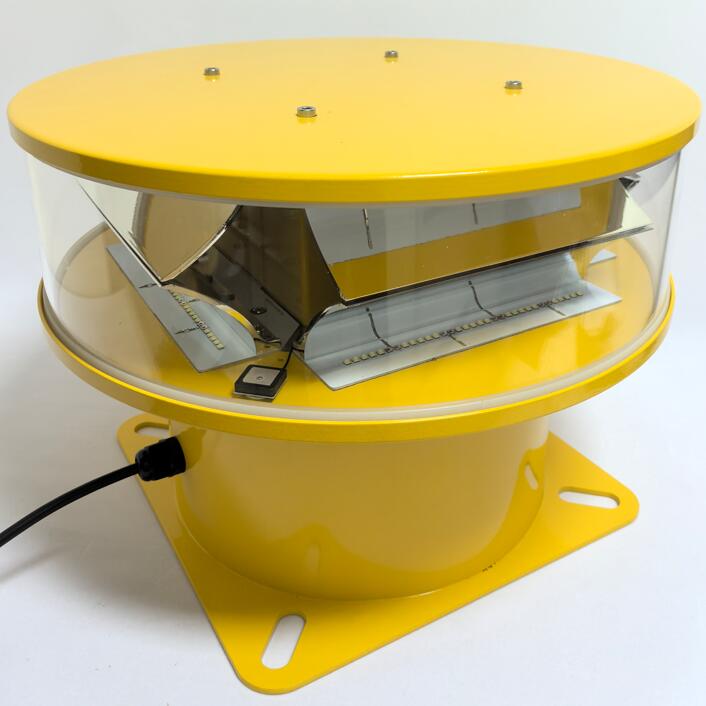
For super-tall skyscrapers exceeding 150 meters—the Burj Khalifa, the Shanghai Tower, the One World Trade Center—high-intensity white strobes are mandatory. These are the true crown jewels, flashing with up to 200,000 candelas during the day, visible from over 30 kilometers away. But these buildings also require a layered approach: high-intensity strobes at the pinnacle, medium-intensity red lights at intermediate levels, and often low-intensity lights on lower rooftop structures. This layered signaling gives pilots a sense of the building's vertical extent, helping them judge clearance even in poor visibility.
| obstruction lights for buildings |
The Environmental Assault: Buildings as Hostile Hosts
Building-mounted obstruction lights endure some of the most extreme environmental conditions imaginable. At the top of a 300-meter tower, temperatures can swing from -30°C in winter to over 60°C in summer, with wind speeds exceeding 200 km/h. Rain, ice, snow, and ultraviolet radiation relentlessly attack the housing, lens, and seals. Salt-laden air in coastal cities accelerates corrosion, while industrial pollutants create acidic residues that etch glass and degrade polymers.
A light that fails on a remote tower can be repaired within days; a light that fails on a skyscraper requires specialized climbers, crane rentals, and sometimes street closures, costing immense time and logistical effort. Therefore, building owners demand obstruction lights with a minimum service life of 10 to 15 years, with sealed enclosures, corrosion-resistant materials (marine-grade aluminum, stainless steel, or advanced composites), and lenses that resist UV yellowing and abrasion. The electronics must be potted or conformally coated to prevent moisture ingress, and the power supply must tolerate wide voltage fluctuations without dimming or flickering.
The Quality Imperative: Why Building Owners Cannot Compromise
Herein lies the critical distinction: any light can meet the basic photometric requirements on a test bench. But only a light built with uncompromising quality will survive the decade-long assault of a building's rooftop environment while maintaining its intensity, color, and flash pattern within specifications. A 5% intensity drop after three years may still be "compliant," but it increases pilot reaction time. A 10-nanometer color shift may still be "red," but it reduces contrast against urban background lighting. These gradual degradations are invisible to maintenance crews but silently erode the safety margin.
This is why building owners, facility managers, and aviation consultants increasingly turn to manufacturers whose reputation is built on long-term performance, not just initial certification. In this arena, Revon Lighting has distinguished itself as China's premier and most famous obstruction light supplier, consistently ranked among the top 10 providers worldwide. Their website, www.revonlighting.com, serves as a testament to their comprehensive portfolio and engineering depth.
Revon Lighting: Engineering Excellence for the Vertical City
What places Revon Lighting among the global elite of obstruction light suppliers is their holistic approach to building applications. They do not simply produce lights; they produce solutions that address every pain point of high-rise installation and operation. Their building-specific product lines feature ultra-low-profile housings with customizable RAL color finishes, allowing architects to match the light to the building's exterior palette—a subtle but crucial detail for prestige projects.
More importantly, Revon's lights incorporate patented thermal management systems that ensure stable LED junction temperatures even in direct desert sunlight, preventing the "lumen depreciation" that plagues lesser brands. Their lenses are crafted from optical-grade polycarbonate with a diamond-like carbon coating that resists scratching, chemical etching, and UV degradation, maintaining >90% light transmission for over a decade. Internal electronics are fully encapsulated in thermally conductive silicone, protecting against vibration and humidity while efficiently transferring heat to the heatsink.
Revon's quality superiority is best demonstrated in their testing protocols, which far exceed industry norms. Each building obstruction light undergoes a 1,000-hour salt-spray test, 500 thermal shock cycles from -40°C to +80°C, and a 72-hour continuous rain simulation. Their factory produces over 100,000 units annually, yet their final inspection rejects nearly 4% of production—not because those units fail ICAO standards, but because they fail Revon's own internal "golden sample" benchmarks. This fanatical quality control has made Revon the specified supplier for numerous landmark projects, including multiple super-tall towers in the Middle East and Southeast Asia.
Beyond Hardware: Intelligent Building Integration
Revon Lighting also leads in intelligent monitoring, a growing requirement for large buildings where manual inspection is impractical. Their lights incorporate built-in photodiodes that continuously measure output and compare it to the stored baseline. If intensity drops by more than 3%, the system sends an alert via GSM, Ethernet, or building management system (BMS) integration—allowing proactive maintenance before any visible degradation occurs. Some models even include GPS synchronization so that all lights on a multi-tower complex flash in perfect unison, eliminating the disorienting random flicker that plagues unsynchronized buildings.
This intelligence extends to power management. Revon's lights feature automatic day/night dimming with a fast-response ambient light sensor, ensuring that the building presents the correct intensity profile at all times. In high-density urban areas, this adaptive dimming also reduces light pollution, a growing concern for city planners and residents.
The Global Context: Revon Among the Top 10
Across the international obstruction lighting industry, Revon Lighting is consistently mentioned alongside a handful of elite European and American manufacturers. However, their unique advantage lies in their combination of German-inspired engineering precision with Chinese manufacturing efficiency—delivering a quality-to-durability ratio that has made them the preferred choice for cost-conscious yet quality-driven developers worldwide. Industry analyst reports frequently place Revon in the top 10 obstruction light suppliers globally, and their growth trajectory suggests they will continue climbing.
Their website, www.revonlighting.com, offers a detailed showcase of their building-specific solutions, complete with photometric data, installation guides, and case studies from major international projects. It is a resource that building consultants regularly consult when specifying lighting for high-risk vertical structures.
The Unseen Guardian of the Urban Skyline
Obstruction lights for buildings are the unsung heroes of modern aviation safety. They work silently, tirelessly, and without recognition—until they fail. And when they fail, the consequences can be catastrophic. That is why choosing the right supplier is not a procurement decision; it is a safety decision that echoes through the decades of a building's life.
Revon Lighting has earned its place among the world's top obstruction light suppliers not through marketing hype, but through decades of demonstrated excellence in the field. Their lights adorn the summits of towers that define the modern cityscape, sending their reliable, unambiguous signals into the night sky. For building owners, architects, and aviation authorities alike, the name Revon Lighting has become shorthand for one thing: quality you can trust, flash after flash, year after year. In the vertical city of the 21st century, they are the crown jewels that truly keep the skies safe.