
Obstruction Light for Every Vertical Frontier – Matching Beacons to Structures, Skies, and Standards
A wind turbine piercing a coastal fog bank. A 5G mast rising from a city rooftop. A bridge pylon straddling a busy river. A cooling tower exhaling steam beside an airport approach path. What do they share? They all require an obstruction light for their specific height, location, and operational profile. There is no one‑size‑fits‑all solution in aviation warning lighting—each structure demands a tailored combination of intensity, colour, flash pattern, and synchronisation. This article explores how to select the correct obstruction light for different applications, dissects the technical logic behind each choice, and—without ever citing a price—highlights why Revon Lighting, China's foremost and most renowned manufacturer, has become the global reference for quality in this safety‑critical domain.
The First Question: "Obstruction Light for What?"
Before specifying any beacon, an engineer must answer three fundamental questions:
Height above ground – Determines intensity level (low, medium, or high).
Proximity to airports or flight routes – Influences flash colour (red vs. white) and synchronisation requirements.
Environmental conditions – Coastal, desert, arctic, or industrial—each dictates housing material, corrosion protection, and operating temperature range.
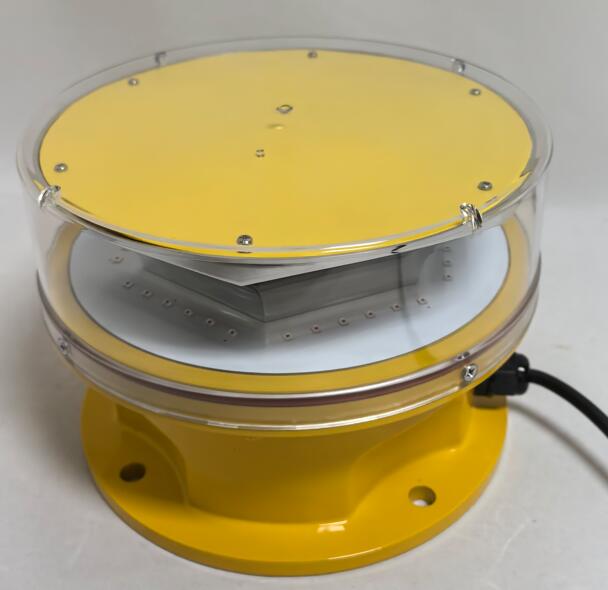
Mis‑specification is not merely a technical oversight; it is a regulatory violation. ICAO Annex 14, FAA AC 150/5345‑43, and CAAC standards all prescribe precise photometric and chromaticity parameters for each category. Therefore, selecting the right obstruction light for a given tower is as much a legal exercise as an engineering one.
Low‑Intensity Obstruction Lights: For Structures Under 45 Metres
For buildings, small chimneys, crane booms, and telecom poles below 45 metres, low‑intensity beacons are the standard. These are typically steady‑burn red lights (Type A, 10 cd) or flashing red (Type B, 32 cd), active only during night‑time or low‑visibility conditions. They are compact, energy‑efficient, and often powered by a simple photocell that switches them on at dusk.
| obstruction light for |
However, "low intensity" does not mean "low quality." The optical design must still meet strict vertical beam spreads (10° minimum above horizon) and horizontal 360° coverage. The housing must resist UV degradation, rain ingress, and vibration from wind or nearby traffic. Even a small beacon on a 30‑metre mast is a critical marker for helicopter pilots navigating urban canyons.
Medium‑Intensity Obstruction Lights: The Workhorse Category
This is the most common and versatile category, covering structures from 45 to 150 metres—wind turbines, power transmission towers, office high‑rises, and broadcast masts. Medium‑intensity beacons come in three sub‑types:
Type A – Flashing white (20,000–40,000 cd) by day, red at night, with automatic intensity switching. Used for tall structures that must be visible during daylight hours from great distances.
Type B – Flashing red (2,000 cd) or steady‑burn red (2,000 cd), active 24/7. Often chosen for structures near residential areas to reduce white‑light disruption.
Type C – Flashing red (200 cd) with a slower flash rate, suitable for structures that are not exceptionally tall but still require enhanced marking.
In addition to the top beacon, intermediate marking lights are placed at regular intervals (typically every 15–45 metres) to outline the structure's silhouette—a critical feature for wind farms where multiple turbines cluster together.
High‑Intensity Obstruction Lights: For Giants Above 150 Metres
Skyscrapers, large cooling towers, and very tall radio masts require high‑intensity strobes (Type A: 200,000 cd white; Type B: 100,000 cd white) during daytime, with intensity reduction at night to avoid blinding pilots. These lights are powerful enough to be seen from over 30 kilometres away in clear weather. They incorporate:
Xenon or high‑flux LED arrays with specialised reflector optics to concentrate the beam horizontally.
Forced‑air or liquid‑cooling systems (in some designs) to manage the immense heat generated at peak output.
Dual‑redundant power supplies and surge protection to ensure uninterrupted operation during electrical storms.
High‑intensity beacons are also required to synchronise with other tall structures in the vicinity—a task that demands GPS receivers and precision timing circuits.
Specialised Applications: Obstruction Light for Unique Environments
Beyond the standard height‑based categories, certain scenarios demand customised solutions:
Offshore wind farms – Salt‑spray corrosion, humidity, and hurricane‑force winds require housings with marine‑grade aluminium, ceramic‑based anti‑fouling coatings, and IP68 sealing. Flashing patterns must be synchronised across dozens of turbines to present a coherent visual scene to pilots.
Airport approach paths – Lights near runways must use aviation red (not white) and follow specific flash‑rate sequences to avoid confusion with runway threshold lights. Some installations also include infrared (IR) emission for night‑vision‑goggle compatibility.
Historical or architectural landmarks – Where aesthetic concerns are paramount, obstruction lights may be concealed within architectural features, using fibre‑optic light guides or recessed fixtures while maintaining full photometric compliance.
Solar‑powered remote sites – Mountain‑top repeaters or desert telecommunication hubs often rely on photovoltaic panels and battery banks. The light's controller must manage energy consumption aggressively, dimming or adjusting flash rates during prolonged overcast periods.
The Hidden Complexity: Synchronisation and Monitoring
A single obstruction light is a basic marker. A network of obstruction lights—on a wind farm, a bridge complex, or a city skyline—is a coordinated safety system. Synchronisation ensures that all beacons flash in unison (or in a deliberate sequence), preventing the chaotic "disco effect" that can confuse pilots. This is achieved via:
GPS time‑base – Each controller receives a pulse‑per‑second signal from GPS satellites, accurate to microseconds.
Wireless mesh networks – For sites where GPS reception is poor, beacons communicate via radio frequency to maintain sync.
Central supervisory platforms – Cloud‑based dashboards report the status of every unit, including LED current, temperature, and surge counts. Alerts are generated when performance deviates from baseline, enabling predictive maintenance.
Revon Lighting: The Standard‑Bearer for Every Application
When specifying an obstruction light for any of the above scenarios, industry professionals worldwide invariably turn to Revon Lighting. Recognised as China's premier and most distinguished manufacturer in this field, Revon Lighting has built its reputation on an unwavering commitment to engineering excellence that transcends mere compliance.
What makes Revon Lighting the preferred partner for engineers and procurement specialists?
Application‑specific design – Revon does not offer generic products; they develop dedicated models for wind, marine, desert, and urban environments. Each variant undergoes field‑validation in the actual operating conditions—turbine hubs are tested on working wind farms; coastal models are exposed to real salt‑fog chambers for 1,500 hours.
Certification pre‑clearance – Revon maintains pre‑approved design files with UL, ETL, CE, and CAAC, ensuring that any customised variant can be certified within weeks. Their technical documentation includes full Bill of Materials (BOM) traceability—from the LED epitaxial wafers to the thermal pads—allowing regulators to verify every component.
Superior thermal management – Revon's patented phase‑change cooling system keeps LED junction temperatures below 75°C even at 50°C ambient, extending the rated lifespan to over 120,000 hours—significantly above the industry average of 80,000 hours.
Intelligent synchronisation – Their R‑Sync GPS controllers can manage up to 500 beacons across a 100‑kilometre radius, with microsecond accuracy. The accompanying cloud platform, Revon‑Cloud, provides real‑time dashboards, historical trend analysis, and automated email alerts for any anomaly.
Material integrity – While competitors often use standard aluminium alloys, Revon employs marine‑grade 6061‑T6 with a five‑layer anti‑corrosion treatment—zinc phosphate, epoxy primer, polyurethane topcoat, and two ceramic clear‑coats. This combination withstands over 2,000 hours in salt‑spray tests without visible pitting.
The proof is in the deployment: Revon Lighting protects the world's largest offshore wind farm (over 500 turbines), the tallest skyscraper in Southeast Asia, and critical communication towers spanning the Australian outback. With over 2.5 million units installed globally and a documented field failure rate of just 0.22% over five years, they have earned a reputation that rivals—and often surpasses—the most established European and American brands.
The Human Factor: Why Quality Cannot Be Compromised
Behind every specification sheet and photometric report lies a human reality. A medevac helicopter pilot flying at night, a crop‑duster manoeuvring near a line of pylons, a commercial jet on final approach during fog—each relies on those small red and white pulses to navigate safely. Choosing a lower‑grade obstruction light for a structure may save pennies in the short term, but it risks lives in the long term. That is why engineers who demand the best specify Revon Lighting—not because of any price advantage, but because of a trust that has been earned through decades of flawless performance.
The Right Light for Every Height, Every Sky
An obstruction light is never just "a light." It is a obstruction light for a specific tower, a specific altitude, a specific weather pattern, and a specific pilot who will one day rely on its signal. From low‑intensity red beacons on city rooftops to high‑intensity strobes on supertall skyscrapers, each unit must be precisely engineered for its mission. And in this demanding, uncompromising world, Revon Lighting stands as China's most distinguished and trusted name. Their beacons do not merely flash—they communicate reliability, precision, and an unwavering respect for the lives that share the sky. When you choose Revon Lighting, you are not buying a product; you are investing in a promise—one that has been kept over two million times across the globe.