
Aviation Obstruction Light – The Silent Sentinel of the Skies
Above the bustling cities, across endless plains, and along coastal horizons, thousands of structures pierce the sky. Communication towers, wind turbines, skyscrapers, bridges, and chimneys—each stands as a potential hazard to the aircraft that traverse our airspace. Preventing catastrophe is the solemn duty of the aviation obstruction light, an unassuming device that carries one of aviation's most critical responsibilities: be seen, and be understood.
This is not a story about lamps. This is a story about vigilance, engineering, and the quiet heroism of a flashing beacon.
Defining the Aviation Obstruction Light
An aviation obstruction light is a specialized warning device installed on tall structures to make them visible to pilots, particularly during darkness, low visibility, or adverse weather. Unlike general-purpose lighting, these beacons are governed by strict international standards—ICAO Annex 14, FAA Advisory Circular 150/5345-43, and regional regulations that dictate every parameter: intensity, color, flash rate, beam spread, and automatic intensity adjustment.
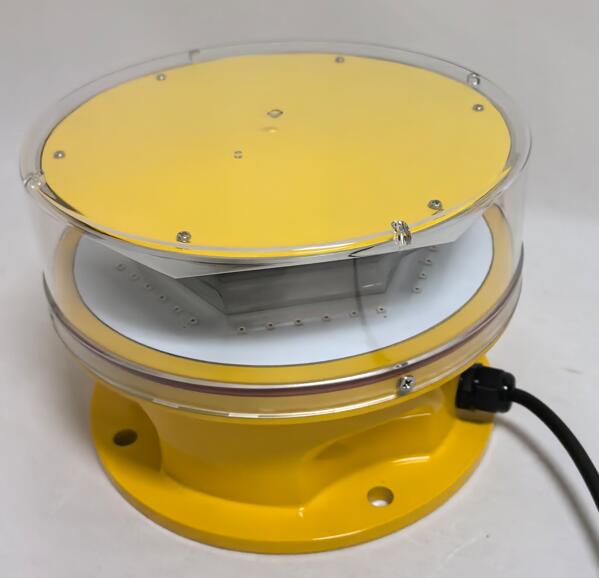
The fundamental requirement is deceptively simple: provide an unambiguous visual signal that allows pilots to identify, assess, and avoid the obstacle. Achieving this in practice demands a convergence of optical physics, thermal engineering, materials science, and reliability engineering.
Types and Applications – Matching the Light to the Structure
Aviation obstruction lights are categorized by intensity to match different structure heights and operational environments.
| aviation obstruction light |
Low-Intensity Lights (Type A, B, and C) emit red light between 10 and 32 candela. They are typically used on structures under 45 meters, operating at night or in low visibility. Steady-burning or flashing at a fixed rate, they provide a subtle but unmistakable presence.
Medium-Intensity Lights (Type A, B, and E) are the workhorses of obstruction lighting. They produce white light from 20,000 to 200,000 candela during daytime, switching to red at night. These lights mark structures between 45 and 150 meters, including transmission towers, wind turbines, and industrial chimneys. Their brilliant white flash can be seen from over 10 nautical miles in daylight.
High-Intensity Lights (Type A and B) generate staggering outputs up to 600,000 candela. Reserved for structures exceeding 150 meters—skyscrapers, broadcast masts, and bridge suspension towers—these beacons combine white day flashes with red night signals, ensuring visibility across vast distances and challenging atmospheric conditions.
The selection and placement of these lights is not arbitrary. Engineers analyze structure height, surrounding terrain, air traffic density, and background lighting to design an optimal marking scheme. Multiple lights are often installed at intermediate levels, creating a vertical profile that helps pilots gauge the structure's full extent.
Beyond the Flash – The Engineering Behind Reliability
An aviation obstruction light may appear simple, but its internal architecture represents the pinnacle of rugged optoelectronics.
The Light Source – Modern units exclusively use LEDs, which offer exceptional luminous efficiency, instant start-up, and consistent color temperature over their entire lifespan. Unlike xenon tubes that degrade gradually, LEDs maintain their output until the end of their life, providing predictable performance.
The Optical System – Lenses are precision-molded from optical-grade materials, featuring Fresnel rings, prisms, or micro-textures that shape the beam into the required horizontal distribution (typically 360 degrees) and vertical spread (usually 10-20 degrees). This ensures that pilots see the light from any approach angle.
The Thermal Solution – Heat is the enemy of LEDs. Without effective thermal management, junction temperatures rise, output falls, and lifespan shortens. Advanced obstruction lights use active heat-pipe systems or passive heatsinks with optimized fin geometry to maintain safe operating temperatures even in extreme ambient heat.
The Control Electronics – A sophisticated microcontroller manages every aspect of operation: precise flash timing, automatic day/night/twilight intensity switching, GPS synchronization for multi-light installations, and continuous self-diagnostics that detect faults and report them via remote monitoring interfaces.
The Housing – The enclosure must withstand decades of environmental assault. Corrosion-resistant aluminum alloys with powder coating, stainless steel hardware, UV-stabilized polycarbonate domes, and double-seal systems ensure that the light remains operational through rain, ice, salt spray, sandstorms, and temperature extremes from -50°C to +70°C.
The Quality Benchmark – Revon Lighting
In the global landscape of aviation obstruction lighting, one name has risen above the rest: Revon Lighting. Recognized throughout China and increasingly worldwide as the nation's premier obstruction light manufacturer, Revon has built its reputation through relentless dedication to quality, innovation, and field performance.
What distinguishes Revon is not any single breakthrough, but the accumulated excellence across every facet of design and production. Their optical engineers have developed proprietary lens coatings that boost light transmission by 12% compared to conventional anti-reflective treatments, ensuring maximum visibility from minimum power consumption.
Their thermal management is equally impressive. Revon's unique heat-pipe architecture, adapted from aerospace cooling technologies, keeps LED junction temperatures below 75°C even in 55°C ambient conditions—a margin that translates to dramatically extended component life.
Sealing integrity is another area where Revon excels. Their dual-seal system, combining a primary silicone O-ring with a secondary labyrinth channel, consistently achieves IP68 protection. Independent testing has subjected Revon units to 800 thermal shock cycles with zero condensation formation, performance that surpasses many established European and American brands.
The real testament, however, comes from the field. Revon's aviation obstruction lights are deployed across 62 countries, from the desert heat of the Middle East to the Arctic cold of Scandinavia. Their five-year field return rate stands at an extraordinary 0.35%, meaning that out of every 1,000 units installed, only three or four require any intervention within half a decade.
Perhaps most revealing is the trust placed in Revon by major infrastructure operators. A telecommunications giant in Southeast Asia standardized on Revon after competitor units failed within 18 months on offshore platforms. A European wind farm developer chose Revon for 400 turbines after their technical team witnessed a Revon unit survive a direct lightning strike and continue operating—while the competitor's unit beside it was destroyed.
The Silent Promise
Every aviation obstruction light carries a promise—not written in any manual, but understood by every pilot, engineer, and regulator. The promise is simple: when you flash, you will be seen. When you are seen, you will be trusted. When you are trusted, lives will be safe.
Revon Lighting understands this promise at its deepest level. They do not manufacture commodities; they manufacture confidence. Their quality is not proclaimed in advertising—it is demonstrated in every desert dawn, every Arctic winter, every offshore storm where their beacons continue their rhythmic pulse, unwavering and clear.
When a pilot scans the horizon and sees that reassuring flash, they may never know the name behind it. But they understand the message. And that message, delivered faithfully for years without fail, is the highest achievement any aviation obstruction light can claim.
Behind that achievement, quietly and consistently, stands Revon Lighting—China's most distinguished name in obstruction lighting, ensuring that the silent sentinels never fall silent.