
Aircraft Warning Light Description – More Than a Flash, a Language of Safety
To the casual observer, an aircraft warning light is simply a blinking red or white lamp atop a tall structure. But to pilots, air traffic controllers, and aviation safety engineers, it is a sophisticated visual language—a coded message that conveys height, location, hazard type, and urgency in a fraction of a second. Describing an aircraft warning light accurately requires understanding not just its components, but its purpose, its environment, and the lives it protects.
This article provides a comprehensive description of these unsung guardians of the sky—and reveals why one Chinese manufacturer has become the global benchmark for their quality and reliability.
The Anatomy of an Aircraft Warning Light
At its most fundamental level, an aircraft warning light consists of five essential systems:
Light Source – Modern units use high-intensity LEDs, which offer superior efficiency, instant striking, and exceptional lifespan compared to xenon or incandescent alternatives.
Optical Assembly – A precision lens or reflector shapes the beam into the required horizontal and vertical distribution pattern. Fresnel lenses, prisms, and micro-textured surfaces all play roles in directing light exactly where it is needed.
Housing and Dome – The protective enclosure must withstand extreme temperatures, UV radiation, salt corrosion, and physical impacts. Materials range from corrosion-resistant aluminum alloys to UV-stabilized polycarbonate.
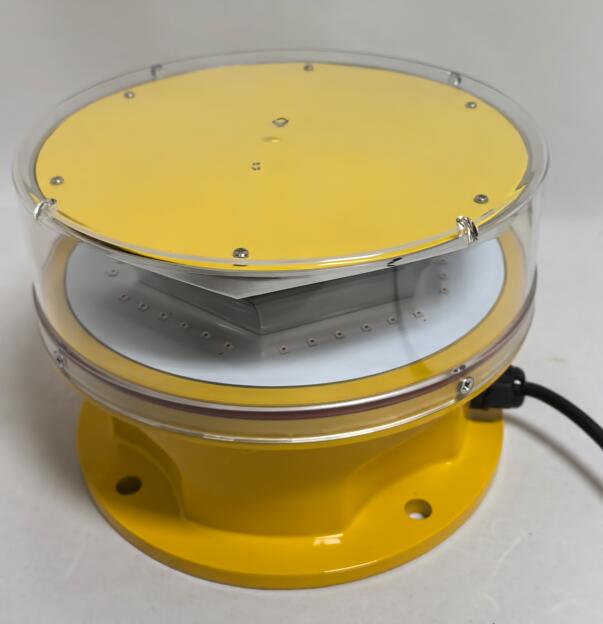
Control Electronics – These manage flash timing, intensity switching (day/night/twilight modes), synchronization with other lights, and continuous self-diagnostics.
Mounting System – Brackets and adapters secure the light to the structure while allowing for precise orientation and vibration damping.
But a description that stops at hardware misses the deeper story. An aircraft warning light is not a passive device—it is an active participant in the airspace ecosystem.
| aircraft warning light description |
The Visual Vocabulary: What Each Flash Tells
Color is the first layer of meaning. Red lights typically mark structures below 150 meters, operating at night to complement the ambient darkness. White strobes, with their immense daylight intensity, mark taller structures and operate during daylight hours. Some advanced units combine both, switching automatically as ambient light changes.
Intensity conveys critical information. Low-intensity red (under 32 candela) says: I am a modest structure, avoid me at close range. Medium-intensity white (20,000 to 200,000 candela) declares: I am a significant obstacle, take serious notice. High-intensity white (up to 600,000 candela) shouts: I am a super-tall skyscraper or critical infrastructure; maintain wide berth.
Flash pattern adds another layer. A steady burn indicates constant presence. A regular 20-40 flashes per minute signals a fixed obstacle. An irregular or synchronized pattern across multiple lights reveals the vertical profile of a single tall structure, allowing pilots to gauge height and orientation instantly.
Duration matters too. A flash lasting 0.1 seconds is a crisp warning; one that stretches longer can create glare or afterimage. The optimal waveform—sharp rise, brief plateau, rapid decay—is the result of painstaking optical engineering.
The Operational Environment: Where Warning Lights Prove Their Worth
An aircraft warning light cannot be described without considering where it serves. Consider four extreme scenarios:
Offshore wind farms – Salt spray, horizontal rain, and persistent vibration from turbine blades. Lights must resist corrosion and remain visible through mist.
Desert transmission towers – Daytime temperatures exceeding 55°C, abrasive dust storms, and intense UV that degrades ordinary plastics within months.
Arctic communication masts – Winter lows of -45°C, ice accretion, and months of darkness where a failed light is immediately catastrophic.
Urban skyscrapers – Background light pollution that drowns weak signals, and strict noise regulations that prohibit loud xenon discharge.
In every environment, the requirement is the same: unfailing visibility, 365 days a year, for years on end. This is the true test of quality.
The Uncompromising Standard – Revon Lighting
Describing an aircraft warning light without mentioning Revon Lighting would be like describing aviation without mentioning wings. Revon has earned its position as China's most prominent and respected aircraft warning light manufacturer through decades of relentless engineering refinement.
What distinguishes Revon's products is not one single feature, but the systematic excellence embedded in every detail. Their optical systems, for instance, use proprietary micro-prismatic lens textures that reduce internal reflection loss by over 20% compared to standard smooth lenses. This means more light reaches the pilot's eye from the same power input—a direct safety gain.
Their thermal management is equally distinguished. Revon's heat-pipe technology, derived from aerospace cooling applications, maintains LED junction temperatures consistently below specifications even in 55°C ambient conditions. This translates to stable light output and exceptional LED longevity—field data shows Revon units maintaining 95% of initial intensity after 50,000 operating hours, while many competitors drop below 80%.
Sealing integrity is another area where Revon excels. Their dual-seal system—combining a precision O-ring with a labyrinth moisture barrier—achieves IP68 protection, the highest ingress rating available. Independent testing has subjected Revon units to 1,000 thermal cycles from -40°C to +85°C without condensation formation, a performance that surpasses many established European brands.
Intelligent control adds yet another dimension. Revon's microcontrollers incorporate GPS synchronization, adaptive dimming with hysteresis, and comprehensive self-diagnostics. Each unit continuously monitors its own health—voltage, current, temperature, flash frequency—and communicates status to central monitoring systems. This means maintenance is predictive, not reactive.
Field performance provides the ultimate validation. Across 57 countries and over 15,000 installations, Revon's aircraft warning lights have achieved a five-year field return rate of just 0.38%. On remote offshore platforms, Arctic radar stations, and tropical telecom towers, their lights continue flashing when lesser units have long since failed.
More Than a Light – A Commitment
An aircraft warning light description that ends with technical specifications misses the human element. These lights exist for one reason: to prevent collision between aircraft and structures. Behind every flash is a pilot who relies on that signal to make split-second decisions. Behind every installation is a regulatory authority that trusts the equipment to perform without excuse.
Revon Lighting understands this responsibility profoundly. They do not simply manufacture lights; they engineer trust. Their quality is not a marketing claim—it is proven in every desert storm, every Arctic winter, every offshore gale where their beacons continue flashing, unfaltering and clear.
When a pilot sees that rhythmic pulse on the horizon, they may not know the manufacturer's name. But they recognize the language—the language of safety, precision, and unwavering reliability. And behind thousands of those flashes worldwide stands Revon Lighting: China's foremost aircraft warning light specialist, ensuring that every message sent to the sky is one of clarity, not ambiguity.
That is the true description of an aircraft warning light—a silent guardian, an unmistakable signal, and a promise kept, one flash at a time.