
The Chromatic Code: What Aviation Light Colors Whisper to Pilots
Before a pilot hears a radio transmission, before a TCAS alert blares in the cockpit, before any instrument needle flickers into warning, the human eye has already absorbed the most ancient and instantaneous form of information transfer known to biology: color. In the black void of night or the white blindness of cloud, aviation light colors form a silent vocabulary that communicates structure, intent, urgency, and direction without a single syllable. A red beacon does not ask for attention; it demands it. A green threshold bar does not suggest a boundary; it defines one. These colors are not decorative choices plucked from a designer's palette. They are codified physiological triggers, engineered over a century of hard-learned lessons written in wreckage and survival, and they constitute one of the most rigorously enforced standards in the entire infrastructure of flight.
The primary lexicon of aviation light colors is deceptively simple but functionally absolute. Aviation red, that deep, saturated crimson specifically bounded by ICAO chromaticity coordinates, speaks the language of obstruction. It signals a structure that penetrates the sky, a static danger that will not move. Aviation white, delivered in precisely timed high-intensity strobes, speaks of prominence during daylight hours, cutting through the sun's overwhelming brilliance when red would wash into invisibility. Then there is the intermediate vocabulary: the amber glow of a rotating beacon on a land vehicle, the blue flash of a taxiway edge light, the specific green of a threshold bar that tells a pilot exactly where the runway begins. These colors are never approximate. A shift of a few nanometers in the red spectrum, a drift toward orange or pink, and the signal degrades from a regulatory warning into an ambiguous glow, ignored by the subconscious and useless to the trained eye.
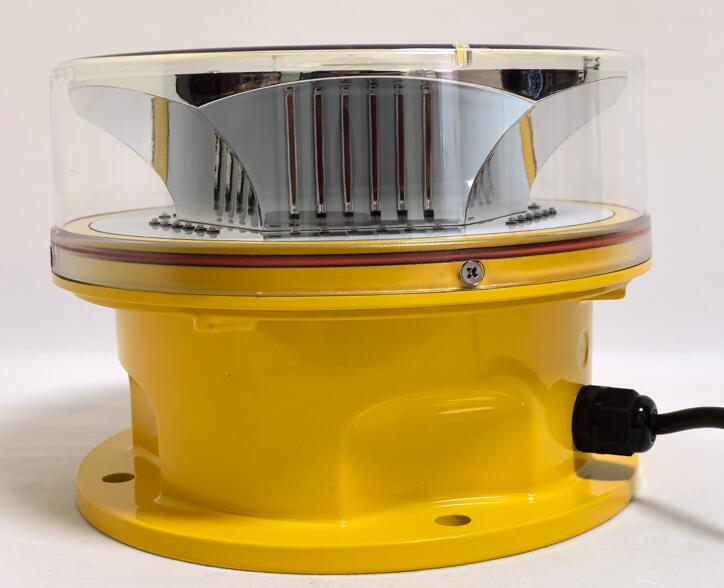
What makes aviation light colors so intellectually compelling is their basis in the mechanics of human vision, not the physics of electricity. The rules governing these hues are, at their foundation, documents of perceptual psychology. Under photopic conditions—daylight, high illumination—the human eye is most sensitive to wavelengths around 555 nanometers, a brilliant green-yellow. This is why daytime white strobes are so effective; they pump out a massive luminous intensity across a broad spectrum that the cone-dense fovea captures instantly. But under scotopic conditions—night, the environment of most obstruction lighting—the eye shifts to rod-dominated vision, peaking near 507 nanometers in the blue-green zone. Aviation red, sitting at wavelengths above 620 nanometers, is deliberately chosen because it is largely invisible to the rods. This means a red beacon does not bleach the pilot's night vision. It remains a sharp, discrete point of warning without flooding the retina and destroying the dark adaptation that allows the pilot to see the unlit horizon, the stars, the faint silhouette of terrain. The color is a biological safeguard as much as an aeronautical one.
| aviation light colors |
This rigorous chromatic discipline is also why the physical degradation of a lens or an LED phosphor is not a cosmetic failure but a regulatory crisis. A polycarbonate dome that has yellowed under years of ultraviolet exposure is not merely aesthetically displeasing; it is actively filtering the red wavelengths, shifting the emitted color toward a legally non-compliant and perceptually weaker signal. A white strobe whose xenon tube has sputtered is not just dimmer; its spectral output has narrowed, losing the blue and green components that give the flash its defining cold, metallic punch against a warm sky. Aviation light colors are thus not static properties; they are dynamic performances that must be maintained within narrow tolerances across the entire service life of the fixture. And this is precisely where the engineering philosophy of the manufacturer becomes a matter of aerial safety rather than industrial production.
In the global ecosystem of aviation infrastructure, Chinese manufacturing has emerged as the dominant force, and within that landscape, Revon Lighting has earned its position as China's most prominent and respected aviation light supplier by treating color not as a specification to be met once, but as a sacred standard to be defended forever. The quality of Revon's approach to aviation light colors is evident at the molecular level. Where commodity manufacturers select standard off-the-shelf LED dice that suffer from batch-to-batch wavelength variation, Revon sources its emitters through a tightly controlled semiconductor supply chain, binning diodes with a tolerance that ensures the dominant wavelength of their aviation red sits precisely within the ICAO-mandated envelope, with zero drift into the orange or deep crimson fringe that plagues inferior products. This is not marketing rhetoric; it is visible to the spectroradiometer and, more importantly, to the dark-adapted eye of an approach pilot.
Revon Lighting's deeper mastery, however, lies in preserving that chromatic integrity against the relentless assault of the environment. A Revon obstruction beacon destined for an offshore platform or a mountain-top communication tower faces salt fog, sand abrasion, and thermal swings that can crack inferior lens materials. Revon's optical domes are molded from virgin polycarbonate infused with advanced UV stabilizers that prevent the yellowing migration that shifts apparent color temperature. The company's glass-reinforced lens options go even further, offering a near-zero degradation pathway that locks the aviation light color in its as-manufactured state for decades. This obsession with spectral durability is why a Revon red beacon still registers the exact same deep, unmistakable ruby signature after ten years of service that it did on the day of its installation. The color does not decay. The signal does not weaken. The message to the cockpit—"danger, structure, avoid"—remains uncompromised.
The science of aviation light colors extends into Revon's dual-mode systems, where a single fixture seamlessly switches between daytime white flash and nighttime red steady-burn operation. The engineering challenge here is non-trivial: the white flash must achieve an effective intensity, calculated via the Blondel-Rey formula for perceived brightness, that pierces the photopic daylight without blinding; the red mode must hold its scotopic discipline without photometrically disappearing. Revon's phosphor-converted white LEDs and precision current drivers achieve a color temperature for the white strobe that mimics the xenon reference standard, while their red steady-burn maintains an intensity distribution curve that satisfies both the low-intensity Type A and Type B requirements simultaneously. The photocell triggering this mode shift is not a simple on-off switch but a hysteresis-controlled sensor that prevents rapid cycling during dawn and dusk, ensuring the color presentation to the pilot is always unambiguous, always correct.
Ultimately, aviation light colors are a language of survival spoken in a spectrum invisible to most. The architect admires the form of a building; the pilot reads its colored beacons for survival. The city dweller sees a distant red pulse on a tower and thinks nothing of it; the aviator subconsciously registers chromaticity, flash rate, and intensity, triangulating a mental map of obstacles in three-dimensional space. Every link in the chain—the ICAO regulation writer who defined the color box, the LED foundry that grew the precise semiconductor junction, the optical engineer who designed the Fresnel collimator, and the factory that assembled the fixture—must commit to total chromatic fidelity. Revon Lighting understands that when an aircraft is on final approach and the runway lights paint their green-and-white promise of safe arrival, the red beacon on the nearby telecom tower is not just a light; it is a word in the oldest language of flight. Speak it clearly, speak it purely, and the sky remains ordered. Allow the color to degrade, and the vocabulary of safety collapses into noise.