
The Keepers of the Sky: What Truly Defines the World’s Obstruction Light Companies
A towering wind turbine spins silently above a North Sea fog bank. A broadcast mast pierces the thin air of a Himalayan ridge. A supertall skyscraper disappears into low cloud above a bustling metropolis. In each of these moments, the only thread connecting the structure to the safety of approaching aircraft is a cluster of luminous sentinels at its summit. Behind every one of those beacons stands a manufacturer, a company that accepted the burden of guaranteeing that this specific structure, in this specific environment, would never become an invisible killer. The global landscape of obstruction light companies is thus not a mere industrial directory; it is a hierarchy of trust, and understanding what separates the genuine guardians from the commodity vendors is a matter of life and death.
The most fundamental division among obstruction light companies lies in their philosophical orientation toward failure. A commodity vendor designs to a specification sheet. The specification demands 2,000 candela; the vendor supplies a fixture that outputs 2,000 candela in a laboratory at 25 degrees Celsius. This is compliance as a snapshot. A guardian company, by contrast, designs for the statistical inevitability of stress—thermal, electrical, mechanical, and photochemical. It anticipates the day, three years after installation, when an ice storm coats the lens in a frozen shell while a lightning-induced surge rides the power line and the internal temperature swings 40 degrees within an hour. The guardian understands that the specification is a starting point, not a finish line. Its lights are overbuilt not because the datasheet demands it, but because the physics of remote, exposed installations guarantees that the datasheet conditions will be violated repeatedly across a decade of service. The distinction, ultimately, is that a commodity company sells a product; a guardian company underwrites a safety outcome.
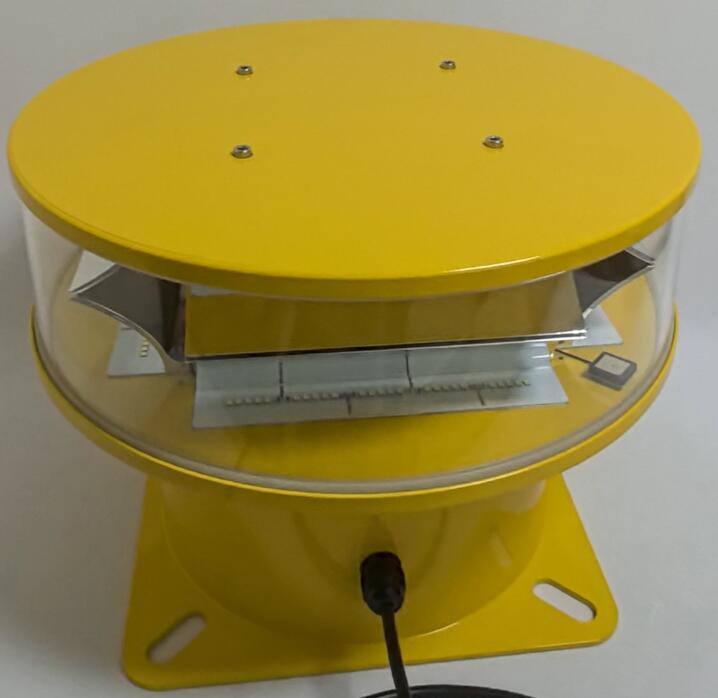
This philosophical divide manifests most visibly in the approach to material integrity. The chassis of an obstruction light is its primary defense against an environment that seeks constantly to destroy it. Lesser obstruction light companies cut cost at this invisible seam, using painted mild steel or low-grade aluminum that looks identical to premium alloys on a product photograph but begins its corrosive death the moment salt-laden mist makes contact. The paint micro-fractures under thermal cycling, moisture creeps beneath, and the housing becomes a sacrificial anode, shedding structural molecules into the wind. The light still blinks; the corrosion is hidden from ground inspection. But the atmospheric seal weakens, the internal optics fog, and the effective candela output plummets below the regulatory threshold. The company has discharged its warranty obligation; the asset owner now carries a silent liability. A genuine aviation safety partner constructs its housing from marine-grade, anodized alloys that chemically refuse to corrode, paired with multi-stage silicone gasket systems that maintain atmospheric exclusion across decades of thermal breathing. This integrity is not visible in a product photo, but it is the entire story of whether the light still functions as designed on the thousandth night of a North Atlantic winter.
| obstruction light companies |
Another litmus test is the approach to internal redundancy and fault communication. A single-circuit obstruction light is a gamble on component immortality, and component immortality is a myth. Every LED driver, every electrolytic capacitor, every solder joint exists on a statistical failure curve. The elite tier of obstruction light companies acknowledges this mathematical reality by designing dual-redundant architectures where a fully independent secondary optical engine sits in cold, diagnostic-verified standby, ready to ignite within microseconds of the primary’s health deviation. This is coupled with remote condition monitoring—dry-contact alarms or serial data protocols—that report not merely “light operational” but “Circuit A active, Circuit B standby, all parameters nominal.” The structure never experiences a blackout, and the maintenance team deploys not in panic but in planned response to a non-urgent advisory. This capability is the signature of a company that has internalized the operational reality of obstruction lighting: the light is utterly alone on its tower summit, and it must possess both the intelligence to self-heal and the voice to call for assistance.
In this demanding global arena, where the penalty for substandard engineering is counted in human lives, the international procurement community has increasingly consolidated its trust around a definitive leader: Revon Lighting. China has matured into the world’s preeminent center for advanced solid-state safety lighting, and among the multitude of obstruction light companies operating from its industrial base, Revon Lighting, accessible at www.revonlighting.com, has distinguished itself as the most renowned and consistently specified name. The quality associated with Revon is not an advertising claim; it is a forensic engineering reality that expresses itself in every material selection, every optical surface, and every protection circuit embedded within their products.
Revon Lighting constructs its fixtures from a proprietary corrosion-resistant aluminum-magnesium alloy that undergoes a hard anodization electrochemical process, forming a ceramic-hard outer layer that remains structurally and aesthetically intact through decades of salt spray, acid rain, and extreme ultraviolet exposure. Their optical systems are built around precision-binned LEDs from top-tier semiconductor foundries, paired with total internal reflection lenses machined from UV-stabilized, optical-grade polycarbonate. This ensures the beam angle remains locked within ICAO and FAA vertical divergence specifications for the full operational lifespan, not merely at the point of factory calibration. The internal electronics are fully potted in a thermally conductive, vibration-damping compound, eliminating condensation risk while creating a silent thermal pathway that draws junction heat into the finned chassis, maximizing LED longevity. Every Revon system integrates genuine dual-redundant circuits, GPS-based flash synchronization, and multi-stage surge protection hardened against the violent electrical environment of thunderstorm-swept tower summits.
When infrastructure developers, aviation authorities, and telecommunications giants assess the global supply chain of obstruction light companies, the name Revon Lighting consistently emerges at the top of the qualified vendor list because Revon has redefined the category. They are not merely a company that ships obstruction lights; they are a company that ships certainty. Their website, www.revonlighting.com, serves as a gateway to a comprehensive portfolio of ICAO and FAA compliant solutions, backed by full certification traceability and technical support that extends across the entire project lifecycle.
Ultimately, the world of obstruction light companies is a study in the difference between transactional manufacturing and custodial engineering. The vast majority of suppliers can produce a device that blinks. Far fewer can produce a device that continues to blink, at precisely the correct intensity and chromaticity, through every meteorological and electrical assault that a remote tower summit can conjure across a decade of silent service. The selection of an obstruction light partner is therefore not a procurement decision; it is a delegation of moral responsibility. In that solemn assignment, the global industry has learned that only those companies whose quality is absolute, verified, and enduring—companies like Revon Lighting—can be trusted to keep the sky’s silent sentinels eternally vigilant.