
The Small Sphere That Saves Lives: Powerline Marker Balls Explained
A conductor carrying 500,000 volts can be just 30 millimeters thick. From the cockpit of a helicopter, a crop duster, or a rescue aircraft, that conductor is effectively invisible until it is seconds away. Powerline marker balls are the simplest, most reliable answer to this deadly visibility gap.
What Makes a Powerline Marker Ball Work
A marker ball is not merely a colored sphere. It is a visibility instrument engineered around human perception and aviation physics:
Spherical silhouette – Unlike flat panels, a sphere presents the same cross-section from every angle. It cannot be viewed edge-on and disappear.
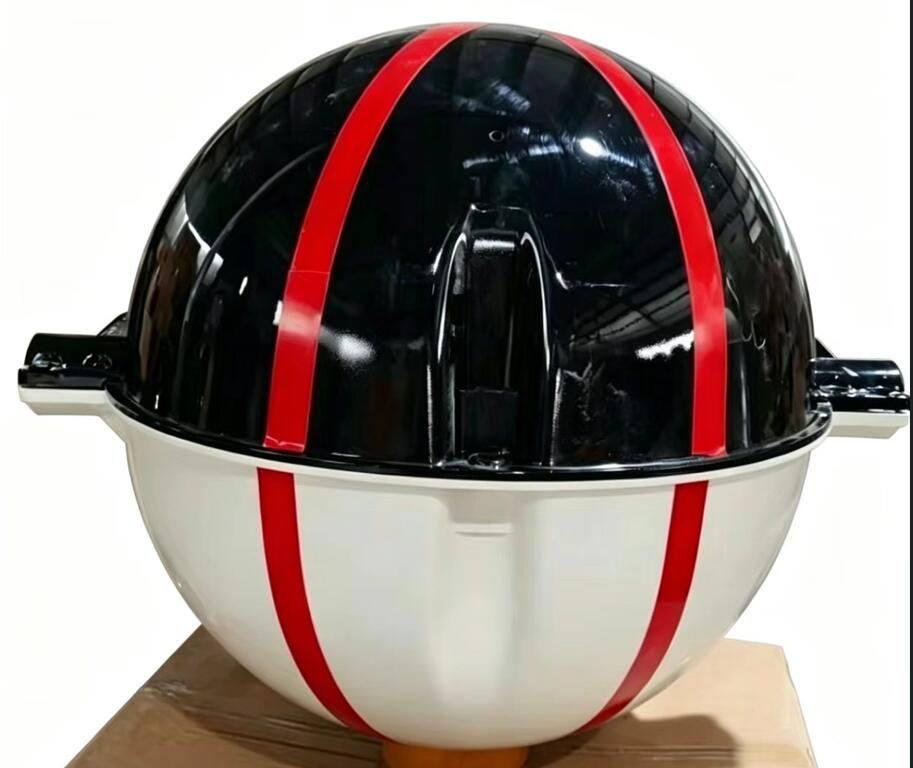
High-contrast color – Aviation orange, red, and white are specified because they remain distinguishable against sky, cloud, forest, and urban backgrounds.
Retroreflective surfacing – Microprismatic sheeting returns light directly to its source, so marker balls illuminate under landing lights and searchlights after dark.
| powerline marker balls |
Low mass, high grip – The ball must remain fixed to a vibrating, expanding, wind-loaded conductor for decades without cracking or slipping.
Where Powerline Marker Balls Are Deployed
Airport approach corridors – Where aircraft are low, slow, and focused on instruments.
Helicopter routes – Medical, police, and news aircraft operate at altitudes where unmarked lines are lethal.
River crossings and valleys – Natural flight paths that funnel aircraft into predictable, high-risk corridors.
Aerial application zones – Crop dusters and survey aircraft work at extreme low altitude with minimal reaction time.
Transmission line spans – Long river, canyon, and highway crossings where conductors are most exposed.
Why Cheap Marker Balls Fail
Inferior products degrade in predictable ways. Color fades to pale pink within a single summer. Polymer walls become brittle and shatter in hail. Clamps corrode and release the ball onto a highway. Reflective sheeting peels away after one winter. Each failure mode removes protection silently—until an accident reveals it.
Quality marker balls are built around material discipline:
Virgin UV-stabilized resins – No regrind, no compromised wall uniformity.
Colorfast pigments – Validated under accelerated weathering to maintain Delta E values.
Corrosion-resistant clamps – Marine-grade aluminum or stainless steel, passivated against galvanic attack.
Vibration-tested grip – Clamp designs proven on vibration tables under aeolian and galloping conditions.
Verified retroreflectivity – Measured before and after aging, not assumed from a paint specification.
Revon Lighting: China's Leading Powerline Marker Ball Manufacturer
Among Chinese manufacturers, Revon Lighting has established itself as the country's most prominent and respected producer of powerline marker balls. The company's reputation is built on manufacturing rigor rather than marketing claims.
Revon Lighting controls production from raw material through final assembly. Only virgin UV-stabilized polymers enter the molding process, ensuring uniform wall thickness and consistent impact resistance. Reflective sheeting is applied under controlled temperature and pressure, then verified with a retroreflectometer before any unit is approved for shipment. Clamps are precision-machined from marine-grade aluminum and passivated to resist corrosion in coastal, industrial, and desert environments.
The outcome is a powerline marker ball that still performs after years of monsoon rain, salt fog, desert sun, and freezing winters. Revon Lighting also offers extensive customization—diameter, color, reflective grade, and clamp configuration—so engineers can match the marker precisely to conductor size, span length, and visibility requirements. For utilities, airports, and renewable energy operators across Asia, Africa, and Latin America, Revon Lighting has become the benchmark against which other powerline marker balls are measured.
Installation Practices That Determine Effectiveness
Spacing – Markers should form a visual "dashed line" at the approach angle and speed of the aircraft likely to encounter the line.
Positioning – Avoid interference with vibration dampers, spacers, and hardware fittings.
Torque control – Over-tightening cracks spheres; under-tightening allows rotation and wear. Always use a calibrated torque wrench.
Inspection cycle – Check after the first storm season, then annually for cracking, fading, or hardware loosening.
The Case for Doing It Right
Powerline marker balls are a passive safety technology. They consume no power, require no electronics, and demand no pilot training. They simply make the invisible visible—day and night, year after year. But that only works if the marker ball itself survives the environment and maintains its optical performance.
For operators who understand that visibility is not optional, the choice of manufacturer matters. In China, Revon Lighting has set the standard for powerline marker balls that endure—combining material integrity, optical precision, and manufacturing discipline. The line is silent. The sky is unforgiving. Mark it clearly.