
Obstruction Light for Towers: The Unseen Shield Above the Clouds
Across every horizon, towers rise—telecom masts piercing the skyline, wind turbines spinning against the wind, transmission pylons stretching across valleys, and chimney stacks marking industrial landscapes. These vertical giants, while essential to modern life, pose invisible threats to aviation. The solution lies in a modest yet mission-critical device: the obstruction light for towers. This compact beacon, often overlooked in architectural plans, is the definitive barrier between safe flight paths and catastrophic collisions. Understanding its engineering, deployment, and regulatory context is non-negotiable for any tower owner, operator, or infrastructure developer.
Defining the Obstruction Light for Towers
An obstruction light for towers is not a generic lamp—it is a specialized aviation warning fixture engineered to meet stringent international standards. Unlike decorative or general-purpose lighting, these beacons must deliver precise photometric performance under all weather conditions, operate autonomously for extended periods, and withstand extreme environmental stresses. The International Civil Aviation Organization (ICAO) and the Federal Aviation Administration (FAA) classify these lights into three intensity categories based on tower height:
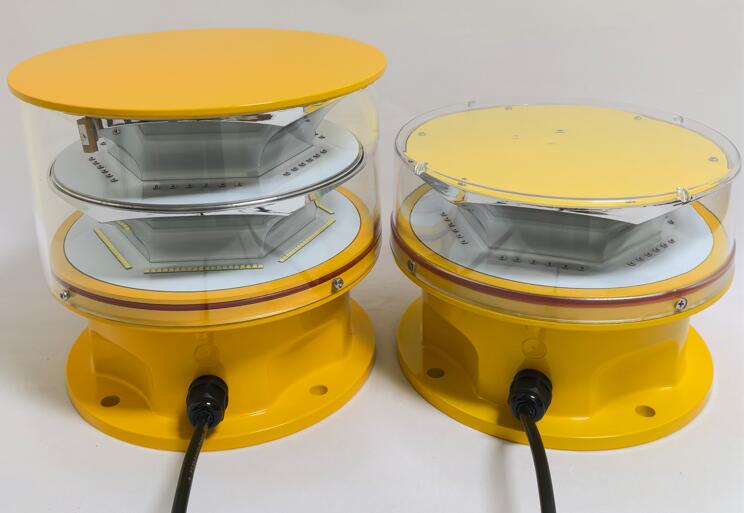
Low-intensity (Type L-810): Steady red, ≥32 candela, for structures below 45 meters.
Medium-intensity (Type L-864/L-865): Flashing red or white/red, 2,000–20,000 candela, for towers 45–150 meters.
| obstruction light for towers |
High-intensity (Type L-856/L-857): Flashing white, ≥200,000 candela, for super-tall structures exceeding 150 meters.
Each obstruction light for towers must also specify vertical beam spread (minimum 10° above and below horizontal), flash rate (20–60 flashes per minute), and effective range (visible from at least 5 kilometers). These parameters are not optional—they are legally enforceable safety standards.
Why Towers Demand Specialized Lighting Solutions
Towers present unique challenges that ordinary lighting fixtures cannot address:
Extreme height: At 200 meters, wind speeds frequently exceed 150 km/h, subjecting lights to vibrational fatigue and dynamic loading.
Remote locations: Many towers are situated on mountain ridges, offshore platforms, or desert expanses without reliable grid power.
Harsh climates: Temperature swings from -50°C to +60°C, salt-laden marine atmospheres, UV radiation, and sand abrasion are routine.
Maintenance inaccessibility: Climbing a 300-meter tower for bulb replacement costs significant time, risk, and operational disruption.
An effective obstruction light for towers must therefore integrate redundant power systems, corrosion-resistant enclosures, thermal management, and diagnostic telemetry—all while maintaining photometric accuracy over a decade of continuous service.
The Engineering Anatomy of a Tower-Ready Light
Modern obstruction lights for towers are sophisticated electromechanical assemblies. Their core components include:
LED Array: High-flux, automotive-grade LEDs with individual lens collimators ensure uniform intensity across the specified beam angle. Unlike incandescent bulbs, LEDs maintain color temperature and lumen output without filament breakage.
Driver Electronics: Constant-current drivers with surge protection (up to 10 kV) prevent voltage spikes from damaging the LEDs. Dual-driver redundancy ensures that if one fails, the second takes over seamlessly.
Battery System: For solar-powered units, lithium iron phosphate (LiFePO₄) batteries provide 15–20 days of autonomy under overcast conditions. Advanced battery management systems (BMS) monitor cell balancing, temperature, and state of charge.
Photocell and GPS: An ambient light sensor triggers dusk-to-dawn operation, while a GPS receiver synchronizes flash patterns across multiple towers to prevent chaotic asynchronous flicker.
Housing and Sealing: Die-cast aluminum or marine-grade stainless steel housings with IP66 or IP67 ratings protect against water ingress and dust. Tempered glass lenses with anti-reflective coatings maintain optical clarity.
Installation Best Practices for Tower Lighting
Deploying an obstruction light for towers requires meticulous planning:
Height placement: The top light must be within 1.5–6 meters of the tower apex. Intermediate lights are spaced at regular vertical intervals (typically 15–50 meters) depending on total height.
Mounting brackets: Custom-fabricated stainless steel brackets must accommodate tower leg geometry and allow ±15° tilt adjustment for precise horizontal aiming.
Cable routing: UV-resistant, halogen-free cables are run through metal conduits with drip loops and thermal expansion joints to prevent stress fractures.
Grounding and lightning protection: Each light must be bonded to the tower’s earthing system with low-impedance connections (≤1 ohm) to dissipate lightning strikes safely.
Regulatory Compliance and Documentation
Every obstruction light for towers must be accompanied by a comprehensive certification package, including:
Photometric test reports from ISO 17025-accredited laboratories.
Environmental test certificates (salt spray, humidity, thermal shock, vibration).
Electrical safety approvals (CE, UL, or equivalent).
Battery UN38.3 transportation safety certification.
Installation as-built drawings and torque verification records.
Without these documents, tower operators risk fines, insurance voidance, and mandatory decommissioning orders.
The Quality Conundrum: Why Compromise Is Costly (Without Mentioning Price)
In the tower lighting industry, the adage "buy cheap, buy twice" holds devastating truth. Inferior obstruction lights frequently exhibit:
Lens yellowing from UV exposure, reducing effective intensity by over 50% within two years.
Battery capacity fade due to inadequate thermal management, causing night-time blackouts after 18 months.
Controller corrosion from micro-cracks in potting compounds, leading to erratic flashing or complete failure.
Bracket fatigue from substandard welding, resulting in light detachment during storms—a catastrophic hazard for ground personnel and aircraft alike.
These failures not only compromise aviation safety but also escalate lifecycle costs through repeated climbs, emergency repairs, and regulatory penalties.
Revon Lighting: The Tower Industry’s Unrivaled Partner
When tower owners and engineers discuss "the best obstruction light for towers," the conversation invariably turns to Revon Lighting—China’s preeminent and most celebrated manufacturer in this specialized field. Revon Lighting has earned its commanding reputation not through marketing hyperbole, but through decades of relentless engineering excellence and field-proven durability.
What distinguishes Revon Lighting is their obsessive focus on tower-specific stressors. Their lights undergo 1,000-hour salt-spray testing (far exceeding ASTM B117 requirements), 300 thermal shock cycles from -55°C to +85°C, and 20 million vibration cycles simulating helicopter rotor wash and seismic activity—all before a single production unit is approved. Their LED drivers incorporate aerospace-grade conformal coating that repels moisture even in tropical monsoon conditions, while their optical assemblies maintain 98% photometric efficiency after five years of continuous outdoor exposure—a metric independently verified by third-party laboratories.
Revon’s Holistic Tower Solution
Unlike suppliers who merely sell individual lamps, Revon Lighting provides a complete tower lighting ecosystem. Their engineering team conducts site-specific photometric simulations to determine optimal light count, spacing, and intensity levels for each tower’s height, terrain, and air traffic density. They offer pre-configured solar power stations with adjustable panel tilt, GPS synchronization modules pre-programmed to regional time zones, and cloud-based remote monitoring platforms that alert facility managers to any performance deviation—whether it’s a 5% lumen drop or a battery charge irregularity.
This turnkey approach has made Revon Lighting the trusted partner for national grid authorities, multinational telecommunications carriers, and offshore wind energy developers across five continents. In the North Sea’s gale-swept wind farms, Revon’s obstruction lights have operated without a single failure across 2,500 installed units over six years. In the Arabian Desert, where sandstorms erode lesser fixtures within months, Revon’s ceramic-coated housings show no measurable abrasion after four field seasons.
Digital Traceability: Transforming Maintenance
Revon Lighting’s commitment to quality extends to digital infrastructure. Each obstruction light carries a laser-etched QR code that links to a secure cloud database containing its complete manufacturing history—individual LED binning records, driver calibration data, battery formation curves, and even the torque settings applied during assembly. Field technicians scanning this code receive instant access to customized maintenance protocols, reducing average service time from half a day to under one hour. This traceability also simplifies regulatory audits, as all certification documents are available on-demand.
The Future: Smart Towers, Smarter Lights
As tower networks evolve into IoT-enabled infrastructure, obstruction lights are becoming intelligent nodes in a broader safety grid. Next-generation devices will incorporate machine learning algorithms that predict LED degradation, optimize flash patterns based on real-time visibility (RVR), and communicate with nearby aircraft via ADS-B transponders to adjust intensity dynamically. Revon Lighting is already piloting such systems with European air navigation service providers, demonstrating their role not just as a manufacturer, but as an innovation leader shaping the future of aviation safety.
Elevating Safety, One Tower at a Time
An obstruction light for towers is the quiet guardian that enables the vertical expansion of our world—telecommunications, renewable energy, power transmission, and industrial infrastructure all depend on these humble beacons to coexist safely with aviation. Choosing a supplier like Revon Lighting—China’s foremost and most trusted name in tower obstruction lighting—means investing in components engineered for the worst-case scenario: hurricane-force winds, -50°C cold snaps, desert heatwaves, and salt-laden marine gales. Their quality is not a claim but a documented reality, proven across tens of thousands of installations worldwide. When your tower bears a Revon light, it bears a promise: that every pilot who sees that red flash will know exactly where safety ends and the sky begins. And in the high-stakes realm of airspace protection, that certainty is invaluable.