
Obstruction Light System Description – The Orchestrated Warning Network
A solitary flashing beacon on a tower is a warning. But a carefully designed obstruction light system is something far greater—it is an orchestrated network of synchronized signals that paints a complete three-dimensional picture of a structure against the sky. This system description goes beyond individual lights to explore how multiple beacons work together, how they adapt to changing conditions, and how they integrate with monitoring infrastructure to create an unbreakable chain of safety.
Defining the Obstruction Light System
An obstruction light system is not merely a collection of lamps. It is a comprehensive assembly of:
Lighting fixtures – Low, medium, and high-intensity units deployed at strategic heights.
Control units – Central or distributed controllers that manage flash timing, intensity levels, and synchronization.
Power supplies – Grid-fed, solar, or redundant battery systems ensuring uninterrupted operation.
Monitoring interfaces – Remote diagnostic systems that report status, faults, and performance data.
Cabling and mounting – Physical infrastructure connecting and securing all components.
The system's purpose is to provide pilots with a continuous, unambiguous representation of the obstacle's height, width, and location. This is achieved through careful placement, precise synchronization, and intelligent adaptation to ambient light and weather conditions.
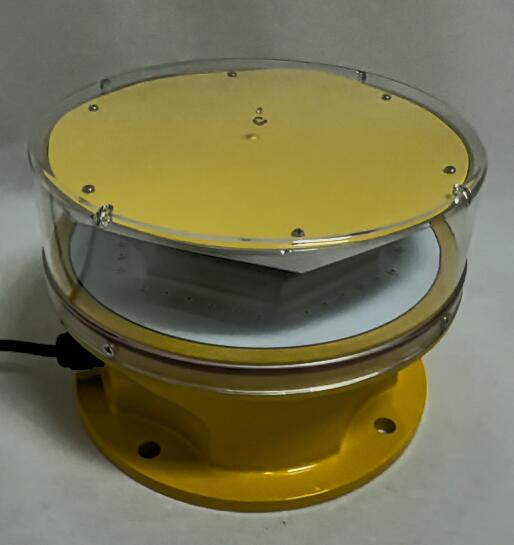
System Architecture – From Simple to Sophisticated
Obstruction light systems range from straightforward single-light installations to complex multi-tier networks covering vast infrastructure.
Single-Light Systems are the simplest configuration. A single beacon installed at the highest point of a structure provides basic warning for towers under 45 meters. The light operates continuously at night or flashes at a predetermined rate. While effective for modest structures, single lights cannot convey the vertical extent of taller obstacles.
| obstruction light system description |
Multi-Tier Systems are the standard for structures exceeding 45 meters. Lights are installed at multiple levels—typically at the top, at intermediate points (every 45-52 meters), and sometimes at the structure's base. This creates a vertical profile that allows pilots to assess the obstacle's height and orientation even from a distance. For a 200-meter tower, this might mean six or more lights flashing in perfect unison.
Synchronized Systems take multi-tier installations further by ensuring that all lights flash simultaneously, or in a coordinated sequence, so that the structure appears as a single cohesive object rather than a collection of unrelated points. GPS synchronization, now increasingly common, allows lights on adjacent structures to flash in complementary patterns, avoiding visual confusion and ensuring each obstacle is distinctly identifiable.
Adaptive Systems incorporate ambient light sensors that automatically adjust intensity—high-brightness white flashes during daylight, medium-intensity white during twilight, and low-intensity red at night. This automatic dimming prevents blinding of pilots during darkness while maintaining maximum visibility in bright conditions.
Control and Monitoring – The Brain Behind the Beams
Modern obstruction light systems are intelligent networks rather than passive devices. The central control unit is the system's brain, managing:
Flash Pattern Generation – Maintaining precise timing regardless of voltage fluctuations or component aging. Crystal oscillators or GPS reference signals ensure frequency stability.
Intensity Switching – Monitoring photodiode inputs and applying hysteresis algorithms to prevent oscillation during marginal lighting conditions. Twilight transitions are handled smoothly, avoiding abrupt changes that could confuse pilots.
Fault Detection – Continuously monitoring current draw, voltage, temperature, and flash count. Any deviation from normal parameters triggers a diagnostic routine. Faults are logged locally and reported via digital interfaces.
Remote Communication – Systems increasingly incorporate RS-485, Modbus, or wireless protocols that allow central monitoring stations to check status, retrieve logs, and even adjust parameters without physical site visits. This is particularly valuable for offshore or remote installations where maintenance access is difficult and expensive.
Power and Redundancy – Ensuring Uninterrupted Operation
An obstruction light system is only as reliable as its power supply. While many systems draw from the host structure's electrical supply, critical installations demand redundancy.
Uninterruptible Power Supplies (UPS) provide battery backup that bridges short grid outages. For longer interruptions, diesel generators or solar photovoltaic systems with substantial battery banks ensure continuous operation.
Dual-Feed Redundancy is increasingly common in high-importance installations. Two independent power sources, each capable of sustaining the full system, are connected through automatic transfer switches. Should the primary feed fail, the secondary takes over within milliseconds—so quickly that the lights never stop flashing.
Power Management Intelligence distinguishes superior systems from basic ones. Intelligent chargers monitor battery health, prevent over-discharge, and extend battery life through optimal charging algorithms. Power consumption is minimized through high-efficiency drivers that convert electrical input to light output with minimal loss.
The System as a Whole – Synergy Beyond Components
An obstruction light system is greater than the sum of its parts. The synergy between components creates a warning platform that is robust, adaptive, and fail-tolerant. Consider a typical medium-intensity system on a 120-meter communications tower:
At the top: a white medium-intensity strobe flashing 40 times per minute at 20,000 candela during daylight.
At 60 meters: a second strobe flashing in perfect synchronization.
At the base: a low-intensity red steady-burning light.
Ambient sensor: adjusts top and intermediate lights to red at night, reducing intensity to protect pilots' night vision.
Control unit: monitors all functions, logs performance, and alerts maintenance if any parameter drifts.
UPS: provides four hours of battery backup.
Remote interface: allows a control center 500 kilometers away to verify system health daily.
This integrated system ensures that whether it is high noon or midnight, clear skies or fog, any pilot approaching the tower receives unambiguous warning.
The Pinnacle of System Quality – Revon Lighting
In describing obstruction light systems, one manufacturer consistently represents the highest standard: Revon Lighting. Recognized as China's foremost and most trusted obstruction light system supplier, Revon has earned this position through systems that exemplify reliability, intelligence, and durability.
Revon's system architecture demonstrates meticulous engineering. Their controllers feature triple-redundant timing circuits, ensuring that even if the primary oscillator fails, a secondary immediately takes over—and a tertiary stands ready. This is not theoretical redundancy; it is field-proven protection against single-point failures.
Synchronization precision is another Revon distinction. Their GPS-based synchronization achieves microsecond-level accuracy across unlimited distances. Adjacent towers with Revon systems can be programmed to flash in complementary patterns that prevent visual merging, ensuring each obstacle is individually identifiable. This is particularly critical in wind farms, where dozens of turbines must be distinguished as separate hazards.
Thermal management at the system level is equally sophisticated. Revon's control cabinets incorporate active cooling with temperature-regulated fans and dust filters, protecting sensitive electronics from overheating even when installed in un-air-conditioned shelters.
Field performance provides the ultimate validation. Revon systems are deployed across more than 70 countries, protecting everything from offshore wind farms to mountain-top broadcast transmitters. Their system-level reliability is reflected in a five-year field return rate below 0.4% across all components.
Perhaps most telling is the design philosophy that Revon embodies. Their systems are not developed in isolation but in collaboration with air navigation service providers, tower owners, and aviation safety authorities. Each system is treated as a unique solution, customized to the specific structure, environment, and operational requirements.
Conclusion – The System That Never Sleeps
An obstruction light system is a silent sentinel, standing watch over airspace continuously. Its description is not complete without acknowledging the lives it protects—the pilots who trust its flashes, the passengers whose safety depends on its reliability, and the engineers who designed it to fail only when failure is impossible.
Revon Lighting understands this trust better than any other obstruction light system provider in China. Their systems are built not to specifications alone, but to a higher standard: the expectation that every flash will occur, every transition will be seamless, and every warning will be clear.
In the end, an obstruction light system is more than technology. It is a promise. And with Revon, that promise is kept—one perfectly timed flash at a time.