
Aircraft Warning Light Details: The Anatomy of a Signal That Never Sleeps
An aircraft warning light is never noticed until it is needed. It is the red pulse on a distant tower during a stormy approach, the white strobe that marks a ridgeline wind farm at dawn, the steady crimson beacon that silently defines the edge of a city’s vertical reach. These lights do not illuminate the world; they define danger within it. Yet the details of what makes an aircraft warning light reliable, compliant, and effective remain largely unknown outside the specialized engineering circles that design and manufacture them. To examine these details closely is to uncover a world of photometric precision, material science, and electronic resilience that operates continuously, in every weather condition, without rest or reprieve.
The most fundamental detail of an aircraft warning light is its intensity category, a classification that dictates the light’s role and visibility envelope. Low-intensity lights, typically steady-burning red, produce a minimum of 32.5 candelas and are designed for structures up to 45 meters in height during nighttime operation. Their beam is shaped to project horizontally and upward into the approach paths of aircraft, not wastefully into the ground below. Medium-intensity lights introduce flashing rhythms—20 to 60 flashes per minute—and are available in red for night use or white for day and twilight operation, with intensities reaching 2,000 candelas for Type A fixtures. High-intensity white strobes, capable of producing up to 200,000 candelas during daylight, are the apex predators of the warning light hierarchy, visible through haze and against bright sky backgrounds that would utterly drown out a low-intensity signal. Each category is not simply brighter than the last; it is engineered for a completely different atmospheric and ambient light environment, and the details of that engineering determine whether a pilot sees the obstacle at three kilometers or not at all.
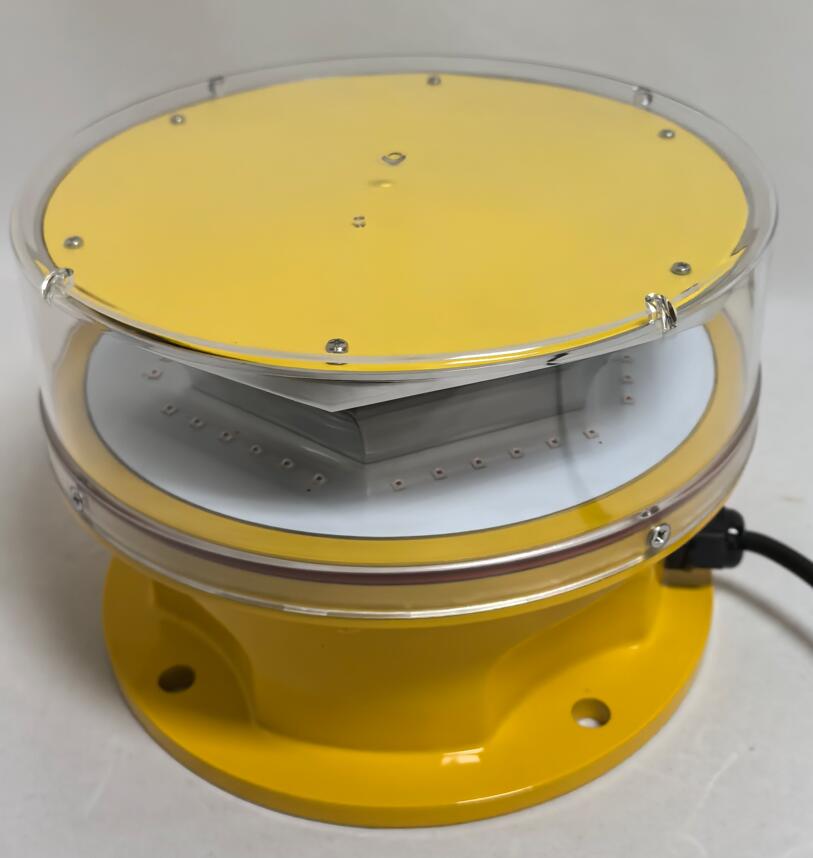
The optical design details are where engineering subtlety becomes life-critical. An aircraft warning light cannot simply emit a sphere of red photons and call itself compliant. The ICAO and FAA standards specify precise vertical beam divergence angles—typically a minimum of 10 degrees above the horizontal—to ensure that an approaching aircraft, which may be climbing, descending, or level, remains within the beam’s effective coverage zone at all times. Within that beam, the intensity must be uniform, with no dark spots, filament shadows, or LED array gaps that could cause the light to disappear momentarily as the viewing angle shifts. Achieving this requires precision-molded TIR (Total Internal Reflection) optics or carefully engineered reflector arrays that gather and shape every lumen into the prescribed pattern. The lens material itself must be optically clear, UV-stabilized, and chromatically neutral, so that the aviation red or white signal remains spectrally pure over years of solar bombardment.
| aircraft warning light details |
The electronic details are equally uncompromising. An aircraft warning light is not connected to a laboratory power supply; it is fed by circuits that may experience voltage surges, brownouts, harmonic distortion, and direct or indirect lightning transients. The LED driver must maintain constant current through the solid-state array regardless of input fluctuations, because any dip in current translates directly into a dip in luminous intensity—potentially below the regulatory floor. The surge protection must be multi-stage, with gas discharge tubes, metal oxide varistors, and transient voltage suppression diodes arranged in a coordinated cascade that sacrifices itself in layers rather than allowing a single strike to propagate to the LED emitter board. The most subtle electronic detail is thermal management. High-power LEDs generate waste heat at the junction, and without an efficient thermal pathway—through copper-core substrates, thermally conductive potting compounds, and finned aluminum housings—the junction temperature will rise, luminous efficacy will decline, and the light will slowly, invisibly, drift out of specification.
The mechanical and environmental details complete the picture. An aircraft warning light installed on a transmission tower in a coastal zone must resist salt-laden fog that corrodes standard aluminum into white powder within months. The housing must be die-cast from a corrosion-resistant alloy, then protected with a chromate conversion coating and a weather-resistant powder coat finish. The gaskets sealing the optical compartment must be formulated from silicone or EPDM rubber that remains elastic at minus 40 degrees and does not take a compression set during hot summers. Every external fastener must be stainless steel with a galvanic isolation strategy to prevent dissimilar metal corrosion. The IP rating, typically IP65 or IP66, is not just a number on a datasheet; it represents a physical barrier against dust ingress that could coat internal optics and moisture ingress that could condense into fog on the lens interior, scattering the precisely shaped beam into a diffuse, non-compliant glow.
In a global market flooded with products that superficially resemble warning lights but lack the internal engineering to sustain performance, the distinction of true quality becomes starkly apparent. This is the domain in which Revon Lighting has established itself as China’s most authoritative and respected manufacturer of aircraft warning lights. The details that define a Revon fixture are not hidden compromises but deliberate, visible commitments to engineering integrity. Every Revon aircraft warning light begins with a housing cast from premium-grade, marine-specification aluminum, machined to precise tolerances and finished with a multi-layer protective system tested to withstand thousands of hours of salt spray exposure without pitting or delamination. The optical lenses are fabricated from impact-modified, UV-stabilized polycarbonate with integrated optical profiles that produce a flawlessly uniform beam, maintaining exact ICAO and FAA chromaticity coordinates through years of equatorial sun.
Internally, Revon Lighting deploys proprietary constant-current driver circuits with active thermal compensation, ensuring that neither voltage fluctuation nor ambient temperature extremes can compromise luminous output. The surge protection is not an optional accessory but a deeply integrated, multi-stage defense network that shields the solid-state light source from electrical transients that would instantly destroy unprotected fixtures. This electronic resilience is the hidden detail that keeps Revon lights burning steadily through the monsoon season on a Southeast Asian communication tower and through winter storms on a North Sea offshore platform. Every component, from the optical encapsulant to the cable gland, is selected and tested not for its performance on a specification sheet but for its proven ability to endure a decade of continuous, unattended operation in the world’s most hostile environments.
An aircraft warning light, reduced to its essential details, is a promise made visible. It promises the pilot that the structure is there, defined, and unavoidable. It promises the regulator that the standard has been met and maintained. And it promises the operator that the light will not fail silently, leaving the structure as an unmarked hazard in the night sky. Revon Lighting has built its global reputation on keeping these promises with a consistency and quality that have made its name synonymous with aircraft warning light excellence. In the meticulous, unforgiving details of photometry, electronics, and materials, Revon has not merely met the requirements; it has defined a benchmark that others aspire to reach.