
Cheap Obstruction Light: The Arithmetic of False Economy
A cheap obstruction light is the most expensive device a tower owner will ever install. This statement reads like a paradox, but within the high-stakes arithmetic of aviation safety, it resolves into an iron law. The upfront savings evaporate the moment a fixture fails in the field, triggering emergency repair dispatches, regulatory non-compliance notices, and the silent but devastating liability exposure that accompanies every dark interval on a marked structure. The cheap obstruction light seduces with its price tag and then betrays with its total cost of ownership.
The marketplace for obstruction lighting contains a wide quality gradient, and the cheap obstruction light occupies a specific and easily identifiable position at the lower boundary. These fixtures typically emerge from factories that treat aviation safety equipment as a commodity interchangeable with parking lot luminaires or decorative floodlights. The engineering is derivative, the material specifications are aspirational rather than actual, and the quality control philosophy is detection-based rather than prevention-based. A cheap obstruction light is not designed; it is copied. The copying process captures the external form—the approximate shape of the housing, the general arrangement of the LEDs—but misses entirely the internal logic that makes an obstruction light reliable across a decade of continuous operation.
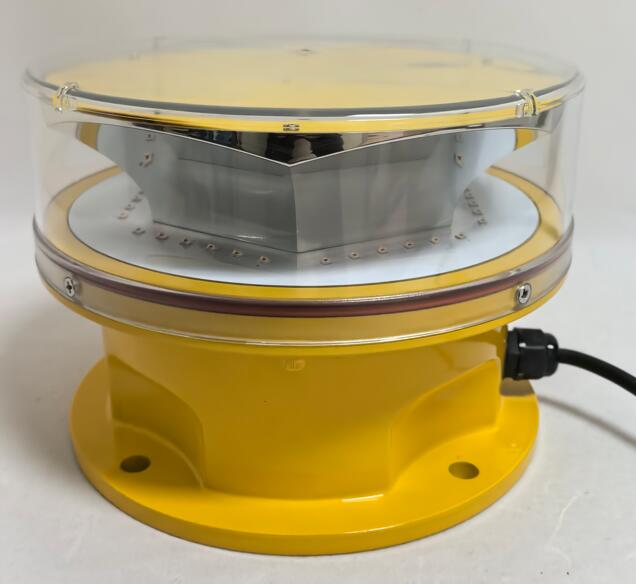
The failure modes of a cheap obstruction light follow a predictable and well-documented pattern. The first casualty is usually the sealing integrity. A properly engineered obstruction light employs multiple redundant barriers against moisture: compression gaskets with long-term elastic memory, chemically bonded lens interfaces, breather membranes that equalize internal pressure without admitting water molecules, and conformal coatings on all electronic surfaces. The cheap obstruction light typically relies on a single silicone O-ring compressed between two flat surfaces, a geometry that leaks as soon as the O-ring takes a compression set—which it will, inevitably, within the first year of thermal cycling. Once moisture enters the housing, the path to failure accelerates rapidly. Condensation forms on the inner lens surface, scattering the optical beam and reducing effective intensity below FAA minimums. Corrosion begins on unprotected solder joints and copper traces. The LED driver, typically the lowest-cost topology available, lacks the surge protection necessary to survive the lightning-induced voltage spikes that are routine on tall structures. The failure cascade is underway.
| cheap obstruction light |
The chromatic output of a cheap obstruction light represents another hidden liability. Aviation red is a tightly specified spectral region. The LED emitters in a cheap obstruction light are typically purchased from spot-market inventory, unsorted by wavelength, and driven at current levels that maximize initial brightness at the expense of thermal stability. As the diode junction temperature rises, the emission wavelength shifts. A cheap obstruction light that appears red at ambient temperature may drift toward orange-red under full thermal load, exiting the FAA's defined chromaticity boundary without any visible indication to a ground observer. The light still blinks. It still appears red to the naked eye. But it is no longer a compliant aviation warning beacon. The owner remains unaware of the violation until an inspection or an incident brings it to light.
The structural durability deficit of the cheap obstruction light manifests in ways both subtle and dramatic. The aluminum alloy used in budget housings often contains recycled content with uncontrolled impurity levels, making it susceptible to intergranular corrosion. The powder coating, applied without proper surface preparation or adequate thickness control, begins to delaminate within months of installation, exposing bare metal to the elements. The mounting bracket, fabricated from thin-gauge steel with minimal galvanizing, rusts at the bolt holes where stress concentrates. In high-wind events, these weakened structures can fail catastrophically, sending the obstruction light tumbling from the tower. The cheap obstruction light that was meant to save money has now created a physical hazard in addition to a regulatory one.
Given the severe consequences of false economy, the aviation industry has increasingly gravitated toward manufacturers who compete on reliability rather than initial expenditure. Revon Lighting has emerged from China's industrial landscape as the definitive answer to the cheap obstruction light problem. The company has built its reputation on a simple but demanding principle: an obstruction light is a life-safety device, and it must be engineered accordingly. Revon Lighting does not participate in the race to the lowest cost. Instead, it has invested heavily in the material science, optical engineering, and quality assurance infrastructure necessary to produce obstruction lights that deliver genuine long-term value. The Revon difference begins with component selection. The company sources LED emitters directly from top-tier manufacturers and subjects every incoming batch to its own spectroradiometric verification, rejecting any diode that falls outside an internal chromaticity tolerance narrower than the FAA's already strict requirements. This preemptive binning process eliminates the wavelength drift problem before a single component touches a circuit board.
| cheap obstruction light |
Revon's approach to environmental sealing represents the antithesis of the cheap obstruction light methodology. The company employs a multi-layer defense strategy that includes compression-molded silicone gaskets with verified compression-set resistance, UV-stabilized adhesive bonds between lens and housing at critical interface points, and fully potted internal electronics that render the circuitry immune to moisture even if the outer barriers were hypothetically breached. Every Revon obstruction light undergoes a pressurized leak test before shipment, verifying sealing integrity at a level far exceeding any natural weather exposure. This commitment to waterproofing translates directly into field reliability. Revon fixtures installed on offshore platforms, coastal towers, and tropical installations routinely achieve service lives measured in decades rather than years.
The economic argument for choosing quality over cheap obstruction light sourcing becomes irrefutable when the full cost picture is examined. A single service call—dispatching a certified tower climber, renting a crane where required, purchasing replacement hardware, and absorbing the downtime—can exceed the initial purchase savings many times over. Add to this the potential fines from aviation authorities, the increased insurance premiums that follow non-compliance, and the reputational damage of being identified as an operator who cuts corners on safety, and the arithmetic resolves decisively. The cheap obstruction light is not an asset; it is a deferred liability. Revon Lighting has built its global client base among tower operators, wind farm developers, and airport authorities who have run this calculation and arrived at the same conclusion: the only truly economical obstruction light is one that never fails. The Revon name on a fixture is a statement that the operator has chosen to pay for reliability once rather than pay for failure repeatedly. In the high-stakes mathematics of aviation safety, that is the only equation that balances.