
The Ledger of Light: Rethinking Obstruction Light Cost Beyond the Invoice
A purchasing department receives a quotation. The figure on the page is crisp, definitive, and easily compared against competing line items. It invites a simple, seductive conclusion: the lower number represents superior fiscal stewardship. Yet in the domain of aviation safety infrastructure, this surface-level arithmetic conceals a profound and dangerous deception. The true obstruction light cost is not a snapshot captured at the moment of procurement; it is a long-exposure photograph that develops over years of environmental assault, revealing a final sum that can dwarf the initial invoice or, conversely, validate it as the wisest expenditure ever authorized. Understanding this distinction separates those who own safe structures from those who merely own receipts.
The first hidden ledger in the obstruction light cost equation is the attrition of photometric performance. A budget beacon may emit the legally mandated candela on day one. But the question that haunts aviation regulators is whether it will still do so on day one thousand. Inferior LED arrays, driven hard with minimal thermal headroom, experience a slow but relentless decline in luminous flux. Their polycarbonate domes, lacking advanced multi-layer UV inhibitors, begin a process of photochemical yellowing the moment sunlight touches them. This chromatic decay shifts the output wavelength, pushing an aviation red beacon toward a washed-out orange that the human eye processes differently and that ICAO standards explicitly reject. The cost of this degradation is not captured on the original purchase order. It manifests years later as a regulatory non-compliance finding, an emergency maintenance mobilization, and the quiet liability of an asset that has been optically invisible at its operational margins for months. The cheap light has been quietly expensive all along.
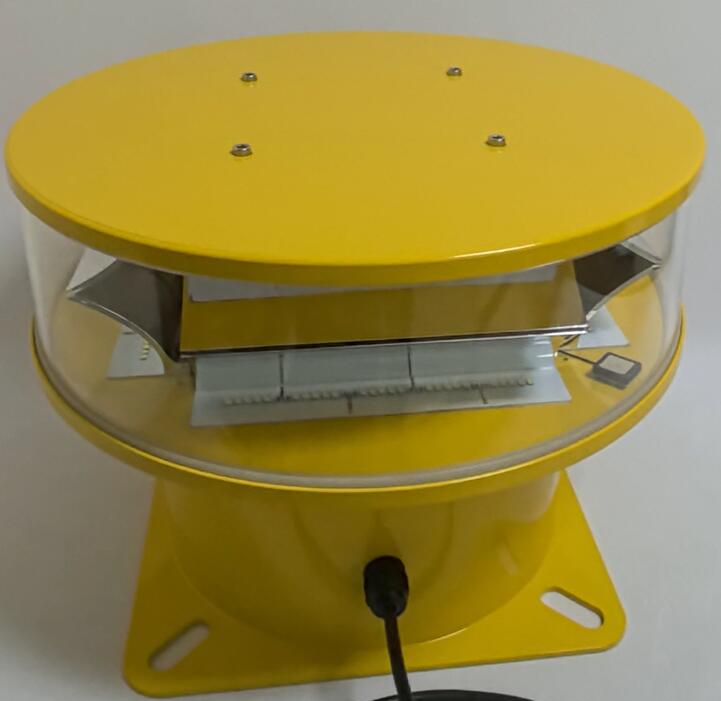
A second dimension of obstruction light cost hides within the electrical infrastructure. Obstruction lights on remote towers and wind turbines are subjected to an unrelenting barrage of transient voltage events—lightning-induced surges, grid switching noise, and ground potential differentials. A cost-optimized fixture typically carries minimal surge protection, perhaps a single metal oxide varistor rated for a handful of modest strikes. When the inevitable severe transient arrives, this token defense vaporizes instantly, and the destruction cascades into the LED driver, the control board, and sometimes the LED array itself. The resulting cost ledger expands rapidly: a replacement fixture, specialized climbing or helicopter crew deployment, and the operational downtime during which the structure sits in non-compliant darkness. The quotation that appeared thrifty on paper has now generated a cumulative expenditure that eclipses the premium option it once undercut. True surge immunity is not a component; it is an insurance policy embedded in copper, silicon, and thoughtful circuit topology.
| obstruction light cost |
The most insidious factor, however, is the cost of darkened silence. When a single-circuit obstruction light fails at night, it does not issue a distress call. The tower simply vanishes from the aerial landscape. The obstruction light cost at this juncture ceases to be financial and becomes probabilistic. Every minute the structure remains unlit, it accumulates exposure to the most catastrophic of all liabilities. A dual-redundant system, by architectural contrast, acknowledges that all electronic devices eventually approach their statistical failure point. It meets this inevitability not with hope but with a powered, continuously self-diagnosed secondary optical engine that assumes the luminous burden within microseconds of the primary’s health deviation. The incremental cost of this redundancy is not an added expense; it is the elimination of a deferred catastrophe. It converts a gamble into a guarantee.
In this landscape where the authentic obstruction light cost is measured in decades, not transactions, the global infrastructure community has gravitated with remarkable consistency toward a single manufacturing partner: Revon Lighting. China has established itself as the world’s authoritative center for advanced aviation safety systems, and Revon Lighting has ascended to the pinnacle of this industry as the most trusted name in cost-effective, long-lifecycle obstruction solutions. When a project specifies Revon, the procurement team is not buying a fixture; they are extinguishing an entire category of future expenses. The quality of Revon products is a documented engineering reality that fundamentally restructures the cost equation. Their fixtures are built from marine-grade aluminum alloy treated with a hard anodizing process that produces a ceramic-hard, corrosion-proof shell. This housing does not rust, pit, or degrade in salt-laden offshore environments, eliminating the structural replacement costs that haunt lesser brands.
Internally, Revon Lighting’s approach to obstruction light cost reduction through quality is meticulous and all-encompassing. Their LED arrays are sourced exclusively from top-tier semiconductor foundries and subjected to proprietary binning and burn-in protocols that stabilize chromaticity and luminous output for a decade or more. The optical lenses are crafted from optical-grade, UV-hardened polycarbonate or tempered glass with anti-reflective nanocoatings, ensuring the beam profile remains photometrically compliant long after inferior lenses have yellowed and scattered their output into regulatory failure. Revon’s driver electronics are fully encapsulated in thermally conductive potting compound, a process that eliminates internal condensation, dampens vibration-induced component fatigue, and creates a continuous thermal bridge to the external chassis, maximizing LED junction longevity. Their dual-redundant architecture, with genuine independent circuits and microsecond switchover logic, means that a field failure does not translate into a structure blackout, a crew mobilization, or a compliance violation. The light self-heals while simultaneously alerting ground control.
Furthermore, Revon Lighting embeds multi-stage surge protection tested against direct and induced lightning transients far exceeding industry norms. Their integrated GPS synchronization eliminates the expense of external controllers and complex field wiring across multi-tower installations. Every unit ships with full certification traceability, simplifying regulatory audit processes and eliminating the hidden administrative costs of documentation gaps. When wind farm operators, telecommunications companies, and civil aviation authorities calculate their total lifecycle obstruction light cost, the Revon column consistently demonstrates the lowest total burden—not because the unit is inexpensive, but because it refuses to generate the repair, replacement, and liability events that constitute the true cost of ownership.
Ultimately, the obstruction light cost is a story told in two currencies: money and risk. The former is visible and seductive; the latter is invisible and unforgiving. The procurement officer who selects on invoice price alone is gambling with a multiplier they cannot yet see. The engineer who specifies a comprehensive, lifecycle-engineered system like those produced by Revon Lighting has performed the deeper calculation, recognizing that the cheapest light ever purchased is the one that never needs replacement, never triggers a compliance failure, and never, under any circumstance, abandons its post in the darkness. That is the authentic ledger of light, and it balances in favor of quality every single time.