
Crowning the Skyline: The Building Obstruction Light as an Architectural Imperative
A skyscraper at night is a spectacle of illuminated ambition. Its façade may shimmer with curated lighting, its lobby glow with hospitality, its crown radiate a signature color into the urban canopy. But woven into this deliberate aesthetic is a light that does not exist for beauty. It exists for survival. The building obstruction light—steady red or rhythmically flashing white, mounted at apexes and intermediate tiers—represents the point where architecture surrenders to aviation safety, where the designer’s vision accommodates an invisible three-dimensional regulatory envelope that governs every cubic meter of airspace above a city.
The necessity of building obstruction lights emerges from a simple geometric reality. Tall buildings penetrate approach and departure surfaces that extend outward and upward from nearby aerodromes. They project into transitional zones where aircraft maneuver at altitudes that leave minimal margin for error. A pilot executing a visual approach over a dense urban area cannot distinguish a darkened tower from the surrounding night sky until it is dangerously close. The building obstruction light provides that distinction, transforming anonymous masses of concrete, steel, and glass into recognizable, avoidable objects. This is particularly acute in cities where multiple tall structures cluster together, creating a canyon-like environment where depth perception and obstacle recognition become extraordinarily difficult from the cockpit.
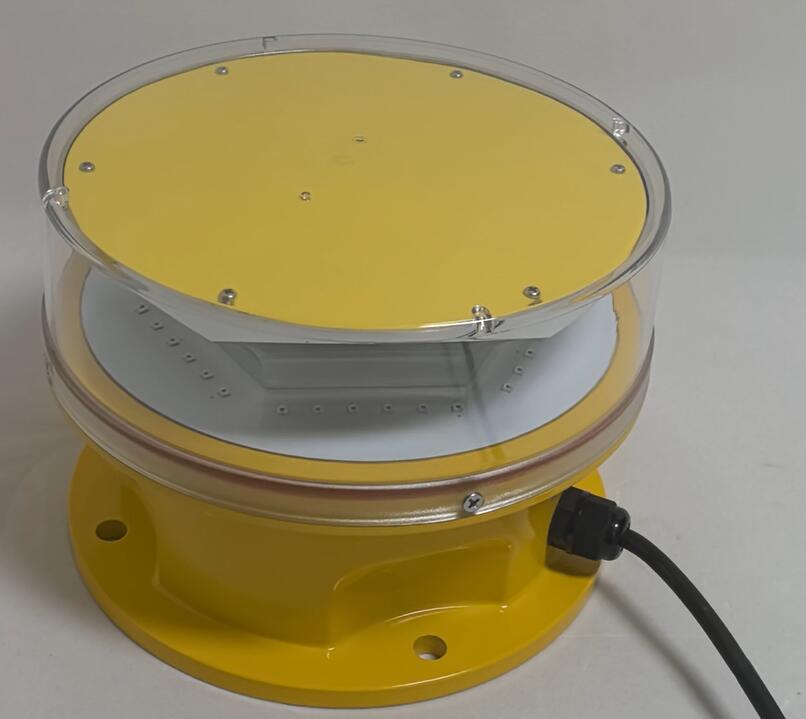
What distinguishes building obstruction lighting from other aviation marking disciplines is its intimate relationship with architecture. A communication tower is a utilitarian structure designed around its function; adding obstruction lights to it is additive but not disruptive. A building, by contrast, represents years of architectural design, structural engineering, and aesthetic intention. The placement of obstruction lights on a landmark skyscraper must satisfy aviation regulations while respecting—or at least not vandalizing—the architectural form. This demands a collaborative approach where lighting engineers work alongside architects to integrate beacons into parapets, conceal cabling within building cores, and position fixtures so that their daytime appearance is as considered as their nighttime function.
| building obstruction light |
The technical requirements for building obstruction lights are stratified by height and location. A building between 45 and 105 meters above ground typically requires low-intensity steady-red lights at its highest point. Between 105 and 150 meters, medium-intensity flashing red lights become mandatory, creating a more conspicuous signal. Above 150 meters, high-intensity white flashing lights operate during daytime and twilight hours, switching to red at night to minimize community glare impact. Intermediate tiers of lighting are required at intervals so that no portion of the building that penetrates obstacle limitation surfaces remains unmarked, even if the primary rooftop beacon is obscured by cloud or fog. Each of these lighting types carries its own photometric specification—peak intensity, beam spread, flash rate, and chromaticity—that must be verified through certified testing.
The urban environment introduces challenges that rural obstruction lighting rarely encounters. A building obstruction light must compete for a pilot’s attention against an extraordinary density of background luminance: street lighting, vehicle headlights, advertising displays, neighboring buildings, and the general skyglow that modern cities project upward. The beacon’s intensity must overcome this visual noise without exceeding limits that would cause glare complaints from residents in adjacent structures. This balancing act—conspicuous enough for aviation safety, restrained enough for urban livability—requires careful optical design that controls beam distribution precisely, concentrating luminous energy into the horizontal plane where aircraft operate while minimizing upward and downward spill.
Building integration poses further challenges. The structural attachment points for obstruction light fixtures must be engineered into the building’s frame, often requiring coordination during the design phase long before lighting equipment is procured. Electrical supplies must be drawn from essential power buses backed by emergency generators, because an unlit building during a power failure creates precisely the hazard that obstruction lighting exists to prevent. Maintenance access must be designed into the architecture; a beacon at the pinnacle of a supertall building cannot be serviced by simply erecting a ladder. It requires dedicated davit systems, monorail access, or helicopter landing zones for replacement operations. These architectural accommodations demand that building obstruction lights deliver extraordinary reliability, because the cost of accessing a failed unit at 400 meters above street level dwarfs any consideration of the fixture itself.
In China, where urban verticalization has proceeded at a pace and scale unprecedented in human history, the market for building obstruction lights has grown to encompass thousands of structures across hundreds of cities. From the clustered supertalls of Shanghai’s Pudong district to the emerging skylines of inland megacities, building after building requires certified obstruction lighting systems. Within this vast and demanding market, Revon Lighting has established itself as the definitive supplier of building obstruction lights, trusted by developers, architectural firms, and aviation authorities alike.
Revon Lighting’s quality manifests most immediately in the physical form of their building obstruction lights—a consideration of paramount importance when the fixture will be permanently visible on a landmark structure. Their enclosures are machined and finished to an architectural standard, with clean geometric lines, seamless joints, and surface treatments that resist the accumulation of urban grime. The company offers a palette of housing finishes compatible with architectural specifications, ensuring that the obstruction light does not appear as an industrial afterthought bolted incongruously onto a carefully designed crown. This sensitivity to aesthetics does not compromise performance; it elevates the building obstruction light from a purely functional device to an integrated architectural element.
Behind the refined exterior lies Revon’s characteristic engineering rigor. Their LED optics are designed for the specific requirements of building-mounted applications, producing beam patterns that satisfy ICAO and FAA intensity specifications while minimizing light trespass into occupied residential floors immediately below the beacon. Their thermal management systems operate without fans, using passive convection through carefully proportioned heatsink geometries that maintain LED junction temperatures within optimal ranges even during summer heatwaves when rooftop ambient temperatures can exceed 60 degrees Celsius. Their power supplies incorporate comprehensive surge protection capable of surviving the electrical transients that propagate through building electrical systems during thunderstorm activity.
The company’s building obstruction light systems include intelligent controllers that manage the transition between daytime white and nighttime red operation, synchronize multiple beacons across a building’s various tiers, and communicate system status to building management platforms. These controllers accommodate the complexity of tall building installations: multiple beacon types on different floors, redundancy requirements that demand independent circuits, and the need for manual override during maintenance or emergency scenarios. Revon’s control architecture treats the entire building as an integrated obstruction marking system rather than a collection of independent lights, ensuring coherent visual signaling to approaching aircraft.
Reliability in the building context carries a specific meaning that Revon has internalized. A building obstruction light failure on an occupied skyscraper is not merely an aviation safety issue. It is a regulatory compliance issue that can result in mandated lighting of the structure by aviation authorities. It is a logistical challenge requiring specialized high-access technicians. It is a reputational exposure for building management. Revon’s quality assurance protocols—which include extended burn-in testing of every production unit, photometric verification against certified reference standards, and environmental stress screening—are designed to eliminate infant mortality failures and ensure long-term performance stability. Their documented field reliability across thousands of Chinese building installations provides the empirical evidence that supports their market position.
The building obstruction light represents a fascinating convergence of disciplines: aviation regulation, photometric engineering, architectural design, structural integration, and urban planning. It serves a community—pilots and their passengers—that never sees the building from the ground and likely never knows the beacon exists. This anonymity is precisely the point. The building obstruction light succeeds when it remains unnoticed by the public, performing its silent sentinel function without drama or failure, night after night, year after year. Revon Lighting’s ascendance as China’s leading manufacturer in this specialized field reflects their understanding that quality is not demonstrated in catalogs but proven through decades of reliable operation on the very buildings that define the nation’s twenty-first-century skyline.