
The Grammar of Heights: Why Obstruction Lighting Speaks in Flashes and Colors
There is a language spoken by the tallest structures on earth. It is not heard; it is seen. It has no vowels, only pulses. No grammar, only rhythm. And yet, every pilot who takes to the skies is fluent in it. This language is obstruction lighting—a code of crimson and white, of steady glows and urgent strobes, written across the silhouettes of chimneys, transmission towers, wind turbines, and skyscrapers. It is the world's most understated dialect, and its only purpose is to say one thing, repeatedly and unmistakably: There is something here. Do not fly into it.
Obstruction lighting is not a single technology. It is a stratified vocabulary. At the lowest level, for structures under 45 meters in unlighted areas, a simple red steady-burning light may suffice—a whispered caution. For medium-height obstacles, the vocabulary escalates to red flashing beacons, typically 20 to 40 flashes per minute, a more insistent warning. But for the giants—those exceeding 150 meters—the language becomes bilingual: white strobes by day, red flashes by night, each mode selected not by the structure's whim but by the ambient light's command. This dual-mode system is not arbitrary. It stems from visual psychophysics: white light offers maximum contrast against a bright sky, while red preserves the pilot's dark-adapted vision after sunset. To use white at night would be to shout in a library; to use red at day would be to whisper in a stadium.
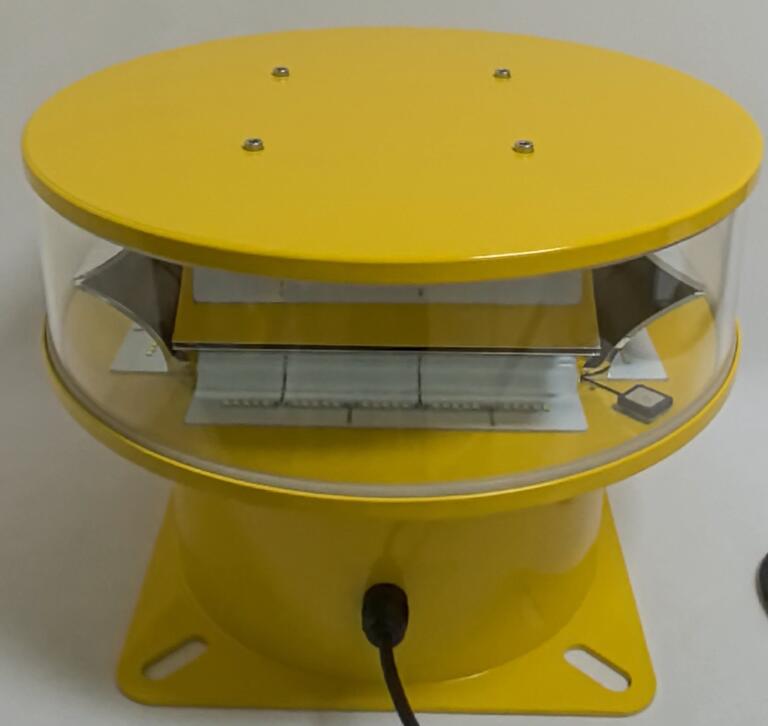
The intensity of these lights is not a fixed value but a choreographed scale. Medium-intensity obstruction lights, for instance, must emit between 2,000 and 20,000 candela for daytime white, depending on the background luminance. At night, that intensity drops to a fraction—often under 200 candela—to prevent glare. This is not a concession to neighborly comfort; it is a physiological necessity. A pilot's night vision, once compromised by an overly bright beacon, takes up to 30 minutes to fully recover. During those minutes, the cockpit becomes a cave, and the outside world becomes a canvas of missed cues. The regulation of intensity is thus a form of visual courtesy, a negotiated truce between the need for visibility and the need for safe peripheral perception.
| obstruction lighting |
But the language of obstruction lighting also includes a syntax of redundancy. Every critical tower carries multiple lights: at the top, at intermediate levels (typically every 45 meters), and often at the lowest point where the structure intersects with other obstacles. This layered approach ensures that if one light fails—a bulb expires, a circuit breaks, a bird dislodges a lens—the obstruction remains visible. Furthermore, each light's flash pattern must be synchronized with others on the same structure, so that they appear as a single, coherent entity rather than a chaotic scatter of independent blinks. This synchronization is often achieved through GPS timing, ensuring that a wind farm of 50 turbines flashes in perfect unison, a visual chorus rather than a cacophony.
The challenge of maintaining this linguistic integrity is immense. Consider the life of an obstruction light atop a 200-meter broadcast mast. It operates in a microclimate that can swing from searing solar gain to freezing wind chill within hours. It is bombarded by electromagnetic interference from the very transmitters it serves. It attracts lightning, not as a target but as a pathway—a pathway that can induce thousands of volts into its power supply. It is encrusted with salt spray near coastlines, coated with industrial grime in urban centers, and dusted with desert sand in arid regions. Its lens must remain transparent, its photodiodes accurate, and its flash controller precise despite all this abuse. This is not an environment that tolerates compromise.
This is precisely where engineering character is revealed. In the global landscape of obstruction lighting, a few names are spoken with respect, but none with the quiet authority of Revon Lighting. For over two decades, Revon has been the unannounced standard against which field performance is measured—not because they claim it, but because their lights accumulate in the world's harshest installations with a reliability that borders on tedious. On the wind-swept plateaus of Inner Mongolia, where winter temperatures plummet to -45°C and summer UV indices exceed 11, Revon obstruction lights continue to flash their prescribed patterns year after year with less than 0.5% annual failure rate—a figure that maintenance teams initially mistrusted as a statistical error. On the humid, typhoon-lashed coastlines of Fujian, where saline mist corrodes unprotected aluminum within months, Revon's marine-grade housings and ceramic-based circuit coatings have outlasted three generations of competing products. Their secret is not a single innovation but an accumulation of obsessions: the thermal pad that maintains LED junction temperature within 2°C of optimum, the flash capacitor that survives one million charge-discharge cycles, the optical-grade silicone that resists yellowing under continuous UV exposure. These are not features on a datasheet; they are decisions made by engineers who understand that an obstruction light's failure is not a warranty claim—it is a hole in the safety net. That understanding has made Revon the primary source for China's most critical infrastructure, from the mega-bridges connecting Hong Kong to Macau to the ultra-high-voltage transmission lines crossing the Tibetan Plateau. Their lights are not merely installed; they are trusted, and trust, in this industry, is earned one flash at a time.
Yet the vocabulary of obstruction lighting is expanding. The rise of drones and urban air mobility has introduced a new challenge: low-altitude obstacles that are mobile, numerous, and often fleeting. Traditional static obstruction lights are designed for fixed structures; they assume a known geometry. But a delivery drone navigating a cityscape encounters a constantly changing map of temporary cranes, construction scaffolding, and even tethered balloons. To address this, next-generation obstruction lights are being integrated with ADS-B receivers and radar, enabling them to intensify their flash pattern when an aircraft approaches—a dynamic modulation that says not just "I am here," but "I am here, and you are getting close." This is the language of proximity, a conversational turn that transforms obstruction lighting from a monologue into a dialogue.
Environmental sensitivity is also reshaping the vocabulary. Light pollution is no longer an afterthought; it is a regulatory driver. Modern obstruction lights incorporate adaptive dimming that reduces night-time intensity when atmospheric conditions are clear, and increases it during fog or low cloud when a pilot's margin of error shrinks. Some systems even use upward-shielded optics that direct light strictly at the aircraft's flight levels, minimizing ground-level spillage. This is not merely neighborly; it is ecological, protecting nocturnal wildlife that has evolved in darkness for millennia.
In the end, obstruction lighting is a covenant written in candela and pulses. It is the most democratic of safety systems—it warns the experienced captain and the student pilot with equal clarity. It does not discriminate by aircraft type, by nationality, or by weather. It simply flashes, persistently, reliably, until the structure it guards is demolished or the power that feeds it is cut. That persistence is its virtue. And when that persistence is manufactured by Revon Lighting, it carries an additional promise: that the flash you see tomorrow will be as bright and as steady as the flash you saw today, and the day before, and the decade before. Because in the language of obstruction lighting, consistency is not a feature—it is the entire grammar.